DigCit: Nineteen Years, 100,000 Students, and One Lawyer Who Needed Stronger Coffee

Nineteen years ago, Aurora Public Schools called me in a panic.  Middle school girls were doing something brand new and unheard of: texting inappropriate pictures on their flip phones (the kind only the rich kids had back then).  The all-male admin team didn’t want to stand up in front of the girls to talk about it, so they looked at me—the female lawyer with a sixth grader at home—and asked if I’d do it.

So I did.  And it was delightful.  We talked honestly about this strange new thing called “sexting.”  Two weeks later, another school asked me if I would come talk to students about cyberbullying.  A month later, another called when a student’s innocent Facebook post had drawn a predator to town.   And just like that, student digital citizenship sessions—what we came to call “DigCit”—were born. 

From the very beginning, three issues came up again and again: bullying, sexting, and internet safety.  And for the next nineteen years, those three issues have never left the stage.

The Numbers That Make My Head Spin

I tried to do some estimating the morning after my last student DigCit presentation.  In the last 19 years, I think I’ve done between 1,000 and 1,300 total DigCit presentations, scattered across the five states in which I am now licensed to practice law.  Let’s say I averaged 100 students per session - which is really pretty low, since I think the groups were usually at least double that.  Multiply that out and we’re looking at more than 100,000 students.  

That is a shocking number.  One hundred thousand Nebraska, South Dakota, Iowa, Kansas and Wyoming kids who sat in a gym or cafeteria or auditorium while I told stories, asked questions, and tried to convince them that maybe, just maybe, they shouldn’t ruin their lives with one stupid moment on a cell phone.

Why It Mattered

Here’s the thing: doing DigCit made me a better lawyer in so, so many ways.

In this job, it's all too easy to forget that we’re doing this for kids.  Being in school buildings two or three times a week let me actually see the kids I serve.  It pushed me to grapple with complex legal issues—the First and Fourth Amendments, questions of intent, and harassment law and then boil that down so a seventh grader could understand it.  It made me understand the law in ways that law school never did.

And the students—oh, the students!  Kids never failed to surprise and (mostly) delight me.  They asked smart, probing, sometimes painfully honest questions.  They gave me accurate, funny and insightful answers to the questions I asked in return.  They shared unfiltered, raw and heartbreaking stories.  I am so grateful for those experiences, and I will never forget those amazing kids.

DigCit was also my first foray into what I now call “preventative lawyering.”  The firm I worked at when I started doing DigCit was perplexed: why would a lawyer talk to students, other than on career day?  But walking into schools gave me the courage to see and then build other things that school clients needed—our policy service, webinar trainings, the administrator evaluation platform, and so much else.  

The Chaos I Loved

Being in so many schools so frequently also reminded me of the chaos educators swim in every day.  One minute I’d be carefully navigating the kindergarten lunch line, and the next I’d be stepping over third graders reading while sprawled in the hallway, only to be escorted past high school biology kids who were totally absorbed in their lesson.

I’d see administrators juggling it all: stopping mid-conversation to take a call about a discipline issue, or wrangling a bus schedule for a kid who needed to get to practice.  It was messy, loud, human, and deeply real.  And I got to be part of it.

The Community

I always loved the community aspect of DigCit.  When I visited a school, I made sure to wear its colors, learn the mascot, and tease the rivalry with whoever they were playing next.  Sometimes I’d get a bonus of eating pork chops at the VFW Club before doing an evening parent session.  I always made a point of stopping for gas on the way out of town - to give a little back to a community that had paid to bring me out to talk to their students.  

All of this gave me a window into how deeply schools are woven into their towns.  Schools aren’t just places where kids learn; they are the heartbeat of their communities.

The Road Warrior Years

Doing over a thousand DigCit adds up to a lot of miles.  I’ve slipped out of the driveway at 4:00 a.m., headlights cutting through the dark; I’ve pulled back in after midnight, too tired to even turn off the radio.  I’ve stolen ten-minute naps on gravel roads before walking into a gym buzzing with seventh graders.

Those drives were sometimes long and lonely, but they also gave me something precious: time.  Time to turn over what had worked, rethink what hadn’t, and dream up ways to make the next session sharper than the last.

Closing This Chapter

Now it’s time to hand the DigCit baton to my KSB colleagues. They are carrying it forward with the grit and heart this work requires.  My role now is to be present where I’m most needed—mentoring the next generation of KSB attorneys and standing with schools through challenges that don’t pause while I’m silencing my phone for a day of student sessions.

But here’s the takeaway: I’m so grateful.  Grateful for the administrators who trusted me.  Grateful for the students who challenged me.  Grateful for the way this work kept me honest about why I became a school lawyer in the first place.   I’ll never forget that when we opened KSB School Law a decade ago, the first check we received came from Wahoo Public Schools—for DigCit presentations.  From day one, and for as long as I’m in this work, it has been—and will remain—about doing our best for kids.

One hundred thousand kids.  One tired lawyer.  And nineteen years of stories I’ll carry forever.  

KSB's Husker Predictions!

They are in! The post you’ve been waiting for! We’re all, well most of us, are excited for the season opener on Thursday! How does KSB think the season will shake out?

KAREN’S PREDICTION:

Every August, I sit down with my Husker schedule, a bottle of tequila Starbucks, and the eternal optimism of a fan who should know better. This year, I’m predicting something radical: progress. Not a playoff berth, not a Heisman, not a national title—just progress. (I know, how dare I dream so big?)

We start with wins over Cincinnati, Akron, Houston Christian, and—brace yourselves—Michigan. Yes, I said Michigan. Nothing would bring me more joy than watching Steve suffer through a Husker upset—like a discount Harbaugh: old, cranky, perpetually annoyed, but without the titles or the NCAA infractions to make him interesting. (Jordan will be there too, clinging to Michigan’s past glory like a barnacle on Steve’s khakis)

Of course, reality always comes knocking. Cue the “Michigan Hangover Loss” at Michigan State—karma for KSBers letting Matt stroll around in his Notre Dame gear, basically just a Michigan fan in rosary beads still living off Rudy reruns. After that, bounce-backs against Maryland and Minnesota, and another ugly Northwestern win. 

Then November arrives, and so does pain: 

USC? Loss. (And while we’re talking about the Trojans, let’s talk Amanda—our very own Trojan horse. She waited until after we hired her to confess she’s an Ohio State fan. That’s not fandom, that’s deception. Honestly, it’s the most Harbaugh move in this office.)

UCLA? Loss. 

Penn State? Loss. 

And Iowa? The turkey leftovers will taste better. Losing to Iowa is bad enough, but Tyler actually chose to go there for law school—proof some decisions haunt you forever. To make it worse, my son is dating an Iowa fan. Pray for me.

In November, even the beer in Memorial Stadium won’t be enough to dull the pain, but at least we won’t be sneaking Busch Light into suspiciously heavy lemonade cups. The lines will be long, the pours will be light, and the bathrooms a disaster—but hey, progress.

And don’t forget this season’s true victims: the kids banned from selling Runzas. Nothing says “Go Big Red” like killing the only reason anyone could justify paying $7 for hot cabbage. RIP pint-sized entrepreneurs—you deserved better.

So there it is: 8–4. Respectable, sure—but the real tragedy is me turning into the kind of optimist I usually mock Bobby. Honestly, I disgust myself.

STEVE’S PREDICTION

You’ve heard it.  I’ve heard it.  Everyone has heard it.  Year 3 under Coach Matt Rhule is THE year for transformation from plucky underachievers to a 10-win juggernaut.  For the sake of the Cornhusker faithful who surround me, I’d love to believe.  I mean, after 20+ years of making fun of Husker fans, it really does feel like I’m punching down.  So is this the year the Cornhuskers finally break out and return to national relevance?  Narrator: No, it is not!

I see 4 gimme wins on the schedule - Akron, Houston Christian (Community College?  Choir?  Daycare? Church League Softball Team?), Michigan State, and Northwestern.  I also see 2 guaranteed losses - Michigan (of course!) and Penn State. The rest?  It’s like walking into Jordan’s office.  You have no idea what you’re going to find!  I say the Huskers split with Cincinnati and Minnesota; split with Maryland and UCLA; and split with USC and Iowa.  That leaves the Huskers with a 7-5 record, because mediocrity is the new tradition!  Disappointing to some, but good enough for another bowl game.  At least you can still say “Wait ‘til next year!”  And, of course, Go Blue (9-3)!

BOBBY’S PREDICTION

Ah, Vegas, you did it again.  Another year, another betting line over/under 7.5 regular season wins.  Re-rolling a $500 under bet for the last 10 years means you could buy a car at this point.  But here I am, ready to get hurt again.  Unlike some national pundits, I’m not close to predicting a playoff run, nor do I think one is necessary to see “progress.”  I’m predicting 8-4 and a flurry of “was that success” discussions come Christmas.  Candidly, I’m mostly just ready for preseason talking to end.  The only thing I need more is the new Taylor Swift album to drop so I can stop hearing about all the theories from my wife, oldest daughter, and Instagram randos.

Cincinnati: I think we finally get that elusive week 1 win against a P4 opponent in a functional home game. They have a solid DL and a dual threat quarterback that will keep it a game until the 4th quarter.  The Bearcats will test our young DL and remade OL and probably even lead in the second quarter, but we settle in and finally get a solid week 1 win.  Bonus prediction: Jason Kelce is seen slamming beers in the suite wearing his old Bearcats jersey he eventually rips off when they score.  Travis will be well behaved because he’s now pop culture’s first man.  Talk about New Heights.

Akron and Houston Christian: A couple wins that will allow us to play the 2nd and 3rd stringers in the second half.  I can see the headlines now.  Back in the top-25 and “this year’s Indiana” stories abound, tied to clicks but not reality.

 Michigan: As much as it pains me, we’re just not quite there yet.  Sherrone Moore will be watching from Ann Arbor, but we lose this one courtesy of a not-yet-settled field goal kicking unit and inability to move the ball.  Side note, who wouldn’t pay $25 million for a National Title? KGB references were not on my college football bingo card.  Thanks, Connor (THE) Stalions.

 Michigan State: Coming off a bye week, now we start the roller coaster only a fragile yet dedicated fanbase signs up for every year.  I think we get this one at home, but it’ll be too close for comfort.  Still, a win is a win.

Maryland: I have absolutely no clue what to make of this team, but I think Nebraska wins it.  The narrative starts to pick up again with a 5-1 record, “also receiving votes” designation, and a “manageable” schedule through October.

Minnesota: I hate that I’m saying it, because there’s only one place PJ Fleck’s oar should be shoved.  At Minnesota on a Friday night just doesn’t go our way.  It’ll be an ugly, cold loss that stings as much as it should.  Here starts the “what could have been” narrative.

Northwestern: A get-back game at home to reach bowl eligibility.  With unease, people will say at least we made a bowl game for consecutive years for the first time in a decade.  My goodness do people love story lines.  It’ll feel super hollow, but it’ll become the narrative.

 USC: Ugh. Another “not quite there yet” loss.  We need to hope it’s snowing and colder than hell.  I have no idea why Lincoln Riley is going to run it back with Maiava at QB. I didn’t see a Riley-esque star taking snaps when we played them last year, and I don’t think he’s “the guy” to take USC to the playoff.  (But now that I’ve said it, congrats on your Heisman run, kid.)  Black will be the uniforms, matching the color of Steve’s soul and the mood in Lincoln.

 UCLA: I think they have this one circled after the debacle in Lincoln last year.  We pull it out in LA, but it’ll be close.  Raiola leads a game-winning drive to get to 7 wins, and Rhule talks about the mental improvement it takes to win close games.  At the same time people start asking, “Where is this Matt Rhule year-3 jump?”

 Penn State: I think they will be good, but not national champion good.  Still, their depth pretty easily wins out this late in the season even though we have 2 weeks to prepare.  We need to hope for an 11 AM kick to have a shot, because a night game at Coach Rhule’s alma mater just isn’t in the cards for us.  I don’t think it is either way.

 Iowa: Ah, yes, the annual “did they finally find a quarterback” roulette for Iowa continues.  Our Aussie punter puts on a show in the cold and wind.  Nebraska wins another ugly one at home to post 8-4, good enough for a “better” bowl game on a random Wednesday night in December.  Then starts 8 months of “was 2025 a successful year?” banter across Nebraska.

SHARI’S PREDICTION:

It’s so great to have football back!  In our house, we’re looking forward to strong Nebraska and Notre Dame seasons.  Yes, we are Notre Dame fans.  Go Irish!  

Now for the Huskers!  I think this might be their best season in a long time.  I think Dylan Raiola will improve significantly this year and the changes in the coaching staff will all be big positives.  Starting the season off on my birthday in Kansas City, they have to win, right?  The next four home games will all be wins.  Michigan will be a good game and we will have to listen to the KSB Michigan fans (boo Steve and Jordan) all week.  But in the end the rest of us will have bragging rights when Nebraska pulls out the victory.  Hitting the road to Maryland and Minnesota.  I think we will win one - Maryland - and lose one - Minnesota.  The Huskers return home and with the hometown crowd they will get a win against Northwestern.  Our next loss comes against USC at home and that’s the start of the rollercoaster.  Win, loss, win!  We will beat UCLA, lose to Penn State, and then head home and win against Iowa.  We will be set up perfectly for another bowl game.  9-3! Go Big Red!  

COADY’S PREDICTION:

Hope Springs Eternal / Groundhog Day.  Those are the feelings that I regularly experience as I write my annual predictions each year.  Being hopeful because this is supposed to be fun (and not self-loathing).  Groundhog Day because that (false?) hope has often proven unfounded in the past.

Still this year, I am genuinely optimistic that Nebraska has actually improved (especially on the offensive line), and that its growth will also show up in the Win-Loss column.  See also Rhule, Matt (Year 3).  Plus, having five straight home games*** and not having to hit the road for a true away contest until October 11, should give Nebraska plenty of runway to get some momentum going.  I see only one sure loss on the schedule: Nebraska’s November 22 trip to Happy Valley.  I am marking down wins against Cincinnati, Akron, Houston Christian, Maryland, Minnesota, Northwestern, and UCLA.  I have the games against Michigan, Michigan State, USC, and [Tyler J. Coverdale’s] Iowa as toss-ups.  I predict that Nebraska will go 9-3.  Bring it on!

***Sorry, Cincinnati; Travis Kelce’s home stadium is going to look and feel more like Memorial Stadium South than a Bearcats . . . ahem . . . “home game.”

JORDAN’S PREDICTION:

I don’t like the taste, but I have to admit that I’m drinking the Rhule-aid this year.  While I have to hope that the Maize and Blue will provide at least one early season disappointment for the blackshirts, a soft schedule should bring Nebraska into the USC game with at least 6 wins.  Assuming they can go .500 down the stretch, we’re looking at an 8 to 10 win season for the ‘Skers.  If they’re lucky, they might even get a second crack at the Wolverines in December.  In any event, this season should be like a cold, fruity, umbrella-ed cocktail to a fat man at the end of a marathon (or at least a walk around the Lincoln office.)

TYLER’S PREDICTION

Five years ago, I was in a fantasy football league where a league member did not have sufficient time to properly research his decisions, and thus left all decisions to fate. Fate being, of course, the quarter he found in his car that he flipped for every single decision.

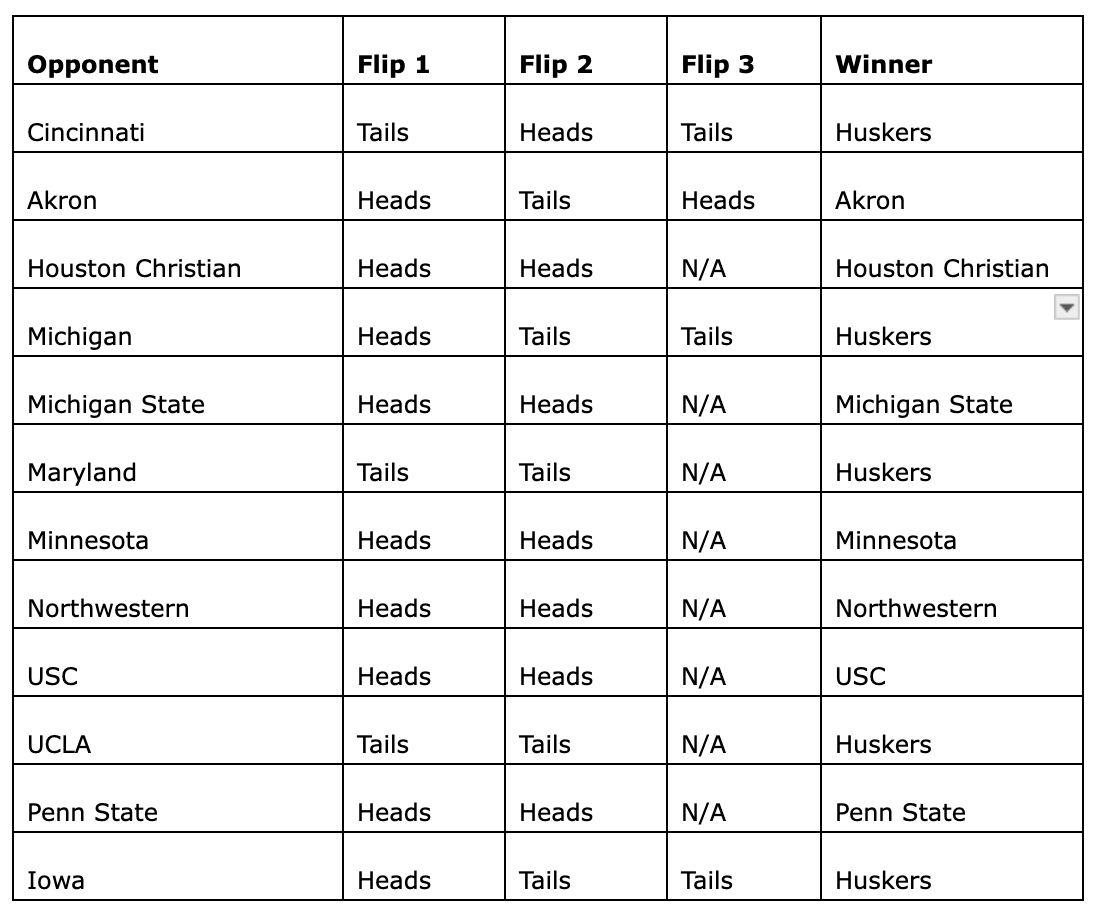
So this year, rather than delve into the blogosphere of Huskermania which is a scary and confusing place to this former Hawkeye, I am instead going to do absolutely no research whatsoever and resign the Huskers to the ultimate decider—the 2015 penny I found under my desk this morning.

Methodology: Opponents are heads, Huskers are tails. Each game is the best 2/3 flips. Clearly I did not flub results or the last game would be different.

Looks like it’s going to be a rough three game stretch in late October/early November since heads came up six times in a row. Also the Penny must have been carried around by the rare Akron/Houston Christian double alumnus for a period of time. 

5-7 and a pretty standard year where the Huskers lose to Houston Christian then beat the Wolverines the next week, and later beat their eastern rival by a score of 9 to 4 or some other nonsense that is typical in those painful-to-watch games (I dropped the coin twice during this match so there will probably be a lot of turnovers in that one). 

SARA’S PREDICTION:

As the KSB resident Husker realist (because nothing screams “millennial coping mechanism” like drafting football predictions while sipping a hazelnut latte and rewatching Gilmore Girls for the 50th time), I’ve reviewed the 2025 Nebraska schedule with all the rigor of a Taylor Swift fan decoding hidden Easter eggs. August kicks off with Cincinnati in Kansas City, basically a road trip that feels like a “Cornhusker Eras Tour” opener. Wins pile up early (Akron and HCU, bless your hearts), but then Michigan rolls in like the villain in every Marvel reboot, reminding us that pain builds character. The mid-season stretch? Let’s just say Northwestern is our “You Belong With Me” moment, while USC and UCLA are the part where the stadium playlist shifts to “All Too Well (10 Minute Version).” The Taylor Swift references, by the way, are in honor of her new album dropping right in the heart of football season, maybe she will give Karen and I royalties for free advertising? (Yes, we know many of you have been personally subjected to the artistry of Taylor Swift music on a webinar with us. Hey T. Swift - if you happen to be reading, I have Venmo!) In true millennial fashion, I’m predicting we’ll end up at a solid 7–5: not too shabby, not too legendary, but just enough to justify buying another Husker crewneck sweatshirt I don’t need. #gobigred 

Ps. Don’t worry, I predict the Huskers will make a bowl game this year. It won’t be anything fancy, but think of it like the streaming equivalent of landing on Hulu instead of Netflix; still solid, still watchable, but with lower expectations of entertainment value. 

AMANDA’S PREDICTION:

Rookie year of predictions? Not bad—I came out of the gate stronger than Nebraska usually does in the fourth quarter. Now in my sophomore season, I’m back at it, taking another swing at calling the Cornhuskers’ fate.

This year, I’m penciling Nebraska in at 7–5. Respectable, bowl eligible, but not exactly striking fear into the Big Ten. Think of it as a season where the fans convince themselves it’s the start of a turnaround—before remembering that The Ohio State still runs the neighborhood. So, how do I see those wins and losses breaking down? Nebraska wins against Cincinnati, Akron, Houston Christian, Michigan State, Maryland, Northwestern, and Iowa. Nebraska will unfortunately take the “L” against Michigan, Minnesota, USC, UCLA, and Penn State. 

Seven wins means the Huskers move the chains a little farther down the field this year. Progress counts—even if the Buckeyes are still marching toward the end zone.

MATT’S PREDICTION:

Another great year for the HUSKERS!!!!

Looking at the schedule maybe 6-6. That’s being nice!

They lose the opener to Cincy 34-28, but blow out wins against Akron and HCU.  Next, Big Ten play!  Nebraska will lose to Michigan, beat Michigan State because the Michigan State offense is bad and can’t score.  Maryland was bad last year and will be at the bottom of the conference again, so the Huskers beat them.  Minnesota will be a good game, I'm thinking 35-31 and the Huskers get the win.  Northwestern is terrible, so another blow out win for the Huskers, but I think the wins stop and they lose to USC, UCLA, Penn State, and also lose a close one against Iowa, like always.  Great news Husker fans, another bowl appearance.

PowerSchool Litigation Update

Did you receive the email about PowerSchool data breach litigation and have questions about what it meant and whether it was something for your school to consider?  Us, too.

The email most clients received is specific to a “mass action” (not “class action”) that has been consolidated in the Southern District of California.  Within that litigation, the school plaintiffs are alleging that PowerSchool breached its contractual obligations to keep data secure and caused administrators to spend time and effort responding to the breach, among other claims.

KSB contacted school attorneys we know in California who are directly involved in the PowerSchool litigation. Specifically, we spoke with Shiva Stein and Mark Williams from the F3 Law firm, who are partnering with the Frantz Law Group—the firm that sent you the initial email. They provided us with a case status update and shared practical details, including the administrative steps for schools that join, how to get started, and the prospects for recovery or settlement.

Shiva and Mark have offered to jump on a zoom to share this information directly with you and answer questions from any schools that may be interested.  The zoom webinar will be held on Wednesday, August 27th at 12:00 CT.  If you’re interested in listening in to this discussion, sign up here.  We’ll also record the zoom so you can access it later if you can’t attend live.  You can also take a look at an explanatory letter about the litigation by clicking here and a litigation FAQ document by clicking here.  Both were prepared by the F3 Law team.

Here are our initial thoughts.  We know you’ve had opportunities to join similar lawsuits—opioids, vaping, and social media, to name a few. The PowerSchool case is different because it involves individual claims from each school rather than a class action. In our view, it’s worth gathering more information for you and your board to consider. With multiple lawsuits already underway against PowerSchool, you may soon face a join-or-opt-out decision anyway. We think the Frantz Law Group/F3 approach offers more control over the process and potential recovery.  As we understand it, they are offering to represent schools on a contingency basis, meaning you shouldn’t have attorney costs unless your district recovers money from the litigation.

If you’d like to talk with one of us about the litigation first, we’re happy to do so.  Give us a call or shoot an email to ksb@ksbschoollaw.com.  Otherwise, consider joining in the Zoom discussion and let us know if you’d like to talk it through after.

**Even though you are already a KSB client and/or elected to receive blog posts from us, it’s possible this blog post is technically considered an attorney solicitation or advertising material.  KSB is not joining in the litigation or giving legal advice to you or those who are involved on the merits of the claims.  We are trying to get the schools we serve information to help them make decisions.** 

Building Your 25-26 In-Service Schedule

In-services. Love them? Hate them? They are a necessary tool built into school calendars. Now that you have your first professional development days of the school year under your belt, now is the time to think about your in-service offerings for the rest of the school year. We noticed with your client satisfaction survey that many schools indicated an interest in new in-service sessions. Look no further! We have a brand new slate of 25-26 in-person in-services for you. Each can be customized to fill the time you have allotted, and we promise your staff will not be bored as a stiff attorney drones on and on. All of these sessions have a target audience of teachers/administrators in a school. 

1. Staying Out of the Headlines: Boundaries, Technology, and Education Professionals

Topics: Employee conduct, online/digital use, professional boundaries, negligence

In a world where one selfie can spark a scandal, you need a digital game plan. We’ll cover what’s safe to share, how to keep boundaries crystal-clear, and how to sidestep those “Why is the superintendent calling me?” moments. Your reputation—and job—will thank you.

2. SPED Declassified: Teacher Survival Guide

Topics: Special education for general education teachers, Section 504, IEP implementation

IEPs and 504 plans aren’t just paperwork—they’re legal documents with serious weight. We’ll translate the alphabet soup of special education into plain English (you know - those acronyms you might have forgotten since college), show you how to meet your obligations without burning out, and keep you compliant (and calm) when the stakes are high.

3. Rulings and Regulations: Real-Life Classroom Implications

Topics: New laws and court decisions—local, SCOTUS, and court rulings

Education law changes faster than the school lunch menu. We’ll break down the newest rulings and regulations, what they actually mean for your classroom, and how to adapt before your next parent conference turns into a legal lesson.

4. Negligence and Supervision: How Teachers can Avoid Liability for Themselves and their Schools

Topics: Student supervision, school safety court cases alleging that teachers, coaches or other staff were negligent 

This session unpacks real court cases involving claims of negligence against teachers, coaches, and staff. We’ll cover practical strategies for student supervision, how to spot risky situations before they escalate, and what steps protect both you and your school from legal fallout

5. Screens, Scandals, and School Rules: What Every Teacher Should Know About Student Devices

Topics: Student digital device use, mental health implications, searches, discipline limits, cyberbullying, cell phone bans, sexting, exploitation

From TikTok trends to text threads, today’s devices bring legal, safety, and mental health challenges straight into the classroom. We’ll cover when you can (and can’t) search a student’s phone, what behaviors can lead to discipline, and how to spot the warning signs of cyberbullying, sexting, or exploitation. Plus, we’ll talk about the mental health impact of constant connectivity and how cell phone bans are playing out in schools.

Looking for on demand content? We have a back-to-school in-service video (but can be utilized at any time!) that is budget friendly and a quick 35 minutes for staff regarding ethics, professional boundaries, and mandatory reporting. If you would like to book a KSB attorney for a staff in-service or check pricing, shoot us an email at ksb@ksbschoollaw.com

The 2025–26 KSB Webinar Lineup Is Live

The 2025–26 KSB Webinar Lineup Is Live

We build our webinars the same way you build your day: around whatever’s on fire.  The 2025–26 lineup is no exception. Whether you’re new to your role or just looking to stay ahead of the legal curve, our webinars are built to give you timely, practical support—with just the right amount of dry humor and digital handouts.

We offering two types of learning experiences:
• Our Quarterly Webinar Series, open to all districts
• Our Nebraska-only Rookie and Refresher Series, with monthly strands for superintendents, principals, special education staff and board members. 

Quarterly Webinar Series (Open to All)

These are three-hour, deep-dive sessions on the hottest legal issues in public education. Each one includes materials, examples, and time for real discussion.

2025–26 Topics:
• Parental rights and opt-outs
• Special ed for general ed leaders
• Testifying in legal hearings
• Activities law, eligibility, and NIL issues

Cost: $1,250 for all four webinars or $325 per session per district. One registration covers your entire building team.

Click here for full session descriptions and to register 

All sessions include access to materials and recordings. You can register for the full series or choose the topics that fit your needs.

Nebraska-Only: Monthly Rookie and Refresher Series

Back by popular demand for 2025–26 with updated content and practical strategies that track the school year in real time.

Principal Series
Starts Sept. 3. Covers special ed, student discipline, evaluations, FERPA, and more.
Click here for full session descriptions and to register

Special Education Series
Starts Sept. 17. Follows one hypothetical student through the IEP cycle with practical, legally sound guidance.
Click here for full session descriptions and to register

Superintendent Series
Starts Sept. 23. Focused on legal fundamentals and timely leadership responsibilities—from contract negotiations and teacher employment to public records, FERPA, and navigating board meetings with confidence.
Click here for full session descriptions and to register

Board Series

Ten short, practical videos built for use in real time—whether your board members watch individually or you embed them into your monthly meetings. Covers everything from confidentiality and executive session to discipline, superintendent evaluation, and individual board member liability. Those who register will also receive updated content throughout the year based on recent changes in Nebraska law.
Click here for full session descriptions and to register

If you're a Nebraska district, you're in. If you're outside Nebraska and wish you had this kind of access, let us know—we’re listening.

*We appreciate those of you who have filled out our client satisfaction survey. If you haven't, please do so here. Based on your responses, we’ll be offering a full training subscription option for the 2026–27 school year. If you'd like access to all available training content on the KSB Portal for this year, please email Shari.

**Most folks assume they’ll just use the same evaluation tool as last year—and that might be fine. But if you’re open to something better, we’ve just launched a new evaluation platform for superintendents and principals. A handful of pilot districts helped us build it, and it’s ready for broader use. Curious? We’re happy to show you around.

***Finally—don’t forget about Title IX. Whether your team needs full team training, “slim” policy training or all staff training, we’ve got options that are easy to roll out and meet federal requirements.

And We Can’t Stop (Implementation)

IEP implementation isn’t a one-hit wonder—it’s a full-length album of services, goals, accommodations, and progress tracking. And just like Miley told us: we can’t stop, and we won’t stop when it comes to implementation.

When it comes to implementation, there are lots of little areas that can lead a district to becoming non-compliant. The case of Benton Sch. Dist., 125 LRP 10676 (SEA AR 2025), covers an increasingly investigated issue: the use of paraprofessionals. 

The district assigned a paraprofessional to support a nonverbal kindergartner with autism in the general education classroom. The paraprofessional ultimately delivered modified instruction and essentially served as the student’s primary provider of special education services without any supervision. 

The hearing officer found that the district denied the student a free appropriate public education (FAPE), in part because it relied too heavily on the paraprofessional. The student’s general education teacher testified that she spent roughly 10 minutes per day with the student. The paraprofessional provided the majority of instruction but was not adequately equipped to provide behavioral supports, had a limited understanding of the student’s complex needs, and received minimal supervision from certificated staff. The student’s IEP also failed to allocate any special education minutes, making it difficult to demonstrate that a certified special education teacher was meaningfully implementing the IEP.

This case, along with the KSB brain trust, has some key takeaways when it comes to implementation:

  • Review the use of paraprofessionals and their supervision. Ensure that appropriately trained and certified staff provide consistent supervision, review how this is documented, and assess the training and support in place for paraprofessionals. Documenting a series of quick check-ins between a supporting paraprofessional and the special education teacher and/or case manager is great evidence of support and supervision.

  • Review your system and how you document IEP access, both for general education teachers and substitutes. Even if not legally required to have a documented system of access, this kind of documentation has proven vital when defending against a complaint.

  • Review the practice in place for tracking and documenting the implementation of services and accommodations. Ensure that we document how and when certified personnel deliver services. If a student rejects an accommodation, we need to document the attempts and refusals.

Sadly, this concludes our summer series on special education compliance. But as Miley said, “It’s our party, we can do what we want to.” Email us at ksb@ksbschoollaw.com with any questions. 

Getting Your Ducks in a Row - Nebraska

The beginning of the school year is one of the busiest times for district leaders—but it’s also when your new administrative team members are at their most vulnerable. That’s why we’ve pulled together some of our most relevant and practical legal resources—ranging from no-cost blog posts to in-depth training modules—to help you set your newest leaders up for success.

Whether you’re onboarding a first-time principal, supporting a new special education director, or helping your business manager navigate FMLA, these Nebraska-specific tools are designed to make your job easier and your school leaders more confident.  

Nebraska Superintendents 

Nebraska Principals

Nebraska Special Education Directors

Nebraska Business Managers

Section 504 Coordinator

We also have a brand new staff in-service training module that you can show during your in-service that discusses hot legal topics staff will need to know for the 2025-2026 school year. If you have questions regarding portal access, pricing for portal content, or general inquiries, please let us know at ksb@ksbschoollaw.com


Getting Your Ducks in a Row - South Dakota

With a new school year fast approaching, the to-do lists are growing—but don’t forget to include your newest leaders. Supporting new administrators starts long before students walk through the doors. We have compiled our resources, which include both paid and free options, to serve as a helpful starting point when considering the support your new team members may need. 

Whether you’re onboarding a first-time principal, supporting a new special education director, or helping your business manager navigate FMLA, these South Dakota-specific tools are designed to make your job easier and your school leaders more confident.  

South Dakota Superintendents

South Dakota Principals

South Dakota Special Education Directors

South Dakota Business Managers

Section 504 Coordinator

We also have a brand new staff in-service training module that you can show during your in-service that discusses hot legal topics staff will need to know for the 2025-2026 school year. If you have questions regarding portal access, pricing for portal content, or general inquiries, please let us know at ksb@ksbschoollaw.com

Ready for Day One: Title IX and SRO Training for Schools

Investing in Title IX and SRO training now will save your district time, headaches, and maybe even a lawsuit later.

Last year, schools were scrambling in late July. New Title IX regulations dropped from the Biden administration, and the clock started ticking toward an August 1 implementation date. Then, a federal judge in Kentucky hit pause just before the Trump administration took office. The current administration has signaled it won’t appeal the stay, leaving districts in the uncomfortable middle—caught between two regulatory frameworks and a lot of legal uncertainty.

No matter who’s running the show in Washington, one thing hasn’t changed: courts still expect schools to train their people and respond when something goes wrong. And while the politics shift, the state mandates—like Nebraska’s 20-hour SRO training—keep coming. The margin for error is thin, and the legal and political expectation to “get it right” is higher than ever.

So what’s a school district to do?

Start with a Training Plan That Actually Works

At KSB, we’ve designed an updated suite of training options to help your team prepare for 2025–26 without wasting time or money. None of this is designed to scare you into compliance—it’s about giving your staff, administrators, and SROs the tools they need to do their jobs well and with confidence. Here’s what’s available:

Title IX Training – Team and Staff Options

For Districts Using the “Full” 2020 Policy
If your board adopted a policy aligned with the full 2020 Title IX regulations, your team needs to be fully trained—and your training materials must be posted publicly on your website. Our on-demand Title IX Team Training (Full Version) meets all those needs. It includes:

  • A 3-hour detailed training video

  • Updated forms for compliance

  • A link and materials for your website

  • District-wide access for $1,250

For Districts Using the “Slim” Policy
Some boards opted for a less exhaustive version that still meets legal standards by focusing on the “deliberate indifference” standard. For those districts, we offer:

  • A 40-minute team training

  • Custom checklists and compliance forms

  • District-wide access for $750

All Staff Title IX Training
Whether you’re using the full or slim policy, all employees, volunteers, board members, and even community coaches need to understand their reporting obligations. Our 25-minute video:

  • Can be watched individually or as part of inservice

  • Includes tracking and completion certificates

  • Costs $500 per district (regardless of the number of individuals who access it)

Click here to register for Title IX Training

SRO Training (State-Mandated)

Nebraska law requires 20 hours of training for both SROs and the administrators they work with.  The training obligation applies if you have an “SRO” as defined by law assigned to your building or buildings.  The training applies both to the SRO(s) and at least one administrator in each building where an SRO operates.  Our training breaks it into manageable, on-demand modules and fulfills the full statutory requirement. ($400 per district)

Click here to register for SRO Training

If you have any questions regarding training, please email shari@ksbschoollaw.com or call the office (402) 804-8000.

Ready for Day One: Title IX Training for Schools

Investing in Title IX training now will save your district time, headaches, and maybe even a lawsuit later.

Last year, schools were scrambling in late July. New Title IX regulations dropped from the Biden administration, and the clock started ticking toward an August 1 implementation date. Then, a federal judge in Kentucky hit pause just before the Trump administration took office. The current administration has signaled it won’t appeal the stay, leaving districts in the uncomfortable middle—caught between two regulatory frameworks and a lot of legal uncertainty.

No matter who’s running the show in Washington, one thing hasn’t changed: courts still expect schools to train their people and respond when something goes wrong. And while the politics shift, the state mandates keep coming. The margin for error is thin, and the legal and political expectation to “get it right” is higher than ever.

So what’s a school district to do?

Start with a Training Plan That Actually Works

At KSB, we’ve designed an updated suite of training options to help your team prepare for 2025–26 without wasting time or money. None of this is designed to scare you into compliance—it’s about giving your staff the tools they need to do their jobs well and with confidence. Here’s what’s available:

Title IX Training – Team and Staff Options

For Districts Using the “Full” 2020 Policy
If your board adopted a policy aligned with the full 2020 Title IX regulations, your team needs to be fully trained—and your training materials must be posted publicly on your website. Our on-demand Title IX Team Training (Full Version) meets all those needs. It includes:

  • A 3-hour detailed training video

  • Updated forms for compliance

  • A link and materials for your website

  • District-wide access for $1,250

For Districts Using the “Slim” Policy
Some boards opted for a less exhaustive version that still meets legal standards by focusing on the “deliberate indifference” standard. For those districts, we offer:

  • A 40-minute team training

  • Custom checklists and compliance forms

  • District-wide access for $750

If you are not a KSB policy subscriber and are interested in purchasing either the 2020 Title IX policy or the “slim” Title IX policy, please send Shari an email.

All Staff Title IX Training
Whether you’re using the full or slim policy, all employees, volunteers, board members, and even community coaches need to understand their reporting obligations. Our 25-minute video:

  • Can be watched individually or as part of inservice

  • Includes tracking and completion certificates

  • Costs $500 per district (regardless of the number of individuals who access it)

CLICK HERE TO REGISTER FOR TRAINING

Other KSB Training for 2025-26 

Although we aren’t ready to open registration yet, we do want to let you know that we’ll continue our Quarterly Webinars, with a “deep dive” into topics offering focused, extended sessions on pressing issues facing school administrators. These will run three hours each and include materials, examples, and time for discussion.

Have questions, want to register your district for Title IX portal content, or want to lock in a date for in-person training? Email Shari at shari@ksbschoollaw.com.

………The Law Less Traveled

Review of Open Meetings Laws

Last week we published our checklist for boards as they head into the new fiscal year. One item we forgot to include was information regarding Senate Bill 74 which passed in the 2025 legislative cycle. That act added SDCL § 1-25-13 which requires a school board to annually review, during an official meeting, the “explanation of the open meeting laws of this state published by the attorney general” and “[a]ny other material pertaining to the open meeting laws of this state provided by the attorney general.” Additionally, the review of this material must be reflected in the meeting minutes. This review has to be completed annually. Linked here is a copy of the Attorney General’s Open Meetings Guide that your board can review. We recommend adding this to your July meeting annually and noting the review in your agenda and minutes. 

Annual Inventory Obligations

Each year, by June 30th, the employees designated by the school board must complete an inventory of all public personal property. SDCL § 5-24-1. This employee is responsible for providing the inventory report to the school’s business manager. SDCL § 5-24-3. Public personal property requiring inventory means “any tangible item other than money, credits, accounts, securities, or real property that is movable, has an expected useful life exceeding one year, and has an initial purchase cost in excess of $5,000.” ARSD 10:02:01:01. We would encourage reviewing your district’s practice for fulfilling these inventory obligations. 

Business Manager Bond

In July, many school boards will set the bond (AKA insurance) required for the school business manager. SDCL  § 13-8-18 provides that “The penal sum of the bonds required for school business managers shall be fixed and approved by the school board.” Business managers - add this to the agenda!

Pay or Indemnify

If a claim has been brought against an officer or employee of a district, and the claim arises “out of an act or omission occurring within the scope of the employment of such employee, or when exercising official duties or responsibilities as an officer or member of such governing board,” then the board has some options. SDCL § 3-19-1. The board can choose to indemnify for costs incurred in the defense, pay or indemnify for reasonable attorney fees, pay or indemnify for a judgment based on the claim, or pay or indemnify for settlement of the claim. If your district finds itself in a situation where someone files a claim or complaint against a board member or employee individually, we encourage you to reach out to your regular legal counsel to discuss the options available. 

As always if you have any questions or feel like there is a law regarding schools that you think is collecting dust, let us know at ksb@ksbschoollaw.com

LRE or Not LRE – That Is the Question

Alas, poor LRE (least restrictive environment)! We knew thee well—until staffing shortages drove the plot off course. In this tale, Miami-Dade Cnty. Sch. Bd., 125 LRP 9104 (SEA FL 2025), a district’s staffing decision led to a drastic change in a student’s special education placement—despite no change in the student’s needs. The outcome? A cautionary tale regarding violating the IDEA’s least restrictive environment (LRE) requirements.

The student, who was verified under SLD and had a medical diagnosis of ADHD, had consistently received part-time instruction in a resource room due to his academic and attentional challenges. The April IEP team meeting reaffirmed the need for this setting—half his day in a resource room, the other half in general education.

Come August, when the student’s mother dropped off school supplies, the principal informed her that the resource room would no longer be staffed. The IEP team reconvened and switched the student to a full-time general education placement, staffed by a teacher with special education certification, with push-in support.

The Administrative Law Judge made it clear: “At the beginning of the next school year, with no change in the student's needs or key data, the school-based members of the IEP team concluded that, based on a staffing decision, the student's placement would change to 100% of his school day spent in a general education class. They reached this conclusion despite there being no change in his disabilities or unique needs. As a result, the change in placement was not tailored to meet his special needs.

Key Takeaways: 

  • Staffing issues, no matter how real, cannot form the basis of placement decisions. The rationale for decisions must be tied back to the individual needs of the student.

  • Be mindful of both the timing and location of discussions. Here, the parent was likely caught off guard by the sudden flip in placement and how it was communicated, which partially contributed to this dispute.

If, as the school year dawns, thou art met with staffing woes that cloud the path of special education, let not uncertainty reign—our counsel standeth ready at ksb@ksbschoollaw.com.

New Fiscal Year, New Checklist: Your July Board Meeting To-Do List

The start of a new fiscal year might not come with a big celebration or champagne (Sidebar: Honestly - it should come with champagne, right? Business managers should be able to celebrate all those fund transfers and finalizations of annual reports!), but it does come with an important meeting. As your board prepares for its annual reorganization meeting, here’s a handy checklist to help make sure you're covering all the essentials.

Designate Your Bank(s) & Custodian Of Funds (AKA Business MGR)

1. Required by SDCL 13-8-10

2. Adopt a resolution at your July meeting naming your district’s bank or banks to be the depository.

3. Pro-Tip: Check the Department of Legislative Audit’s list for under-collateralized banks, if applicable

Elect Your Board Officers

1. Required by SDCL 13-8-10

2. Elect a President and Vice President from among the current board members.

3. Officers serve until the next annual meeting.

4. Reminder: Review your board policy to confirm your election procedures.

Prepare for Tie Votes

1. No statutory tie-breaker exists for officer elections.

2. Check if your board policies include a method for resolving election ties.

3. Boards using KSB Policy 2002 likely already have a tie-breaking process in place.

Administer Oaths of Office

1. Discussed in SDCL 13-8-14 and 13-8-15

2. Newly elected board members must take and sign an oath to uphold the U.S. and South Dakota Constitutions and perform their duties.

3. Oaths are filed with the business manager, except for the business manager’s oath, which goes to the county auditor.

4. Oaths only need to be completed once per person during their term.

5. Both the business manager and board president can administer oaths.

Designate Your Legal Newspaper

1. Required annually required by SDCL 13-8-10

2. Designate the newspaper where all official notices and proceedings will be published.

(Optional, But Recommended) Review Committee Assignments 

1. Many boards will use the reorganization meeting to assign committees with new members now seated.

2. The Board President has sole authority to appoint all committees, so take this step after officers are elected (SDCL 13-8-26). 

(Optional, But Recommended) Designate Legal Counsel

1. Many boards use the July meeting to name the law firm(s) they’ll work with in the coming year.

2. There is no legal limit on how many firms you can authorize.

3. Need sample language? A sample agenda item and motion is available.

The July meeting sets the tone for the year. Use this checklist to ensure your board is organized, compliant, and ready to lead. Additionally, as you prepare for the coming year, consider booking your staff inservices or explore the on-demand portal content for staff professional development offered by KSB, including a 45 minute staff-inservice video available at the end of July. Questions? We’re here to help. Reach out anytime at ksb@ksbschoollaw.com or (402) 804-8000.

Don't Stop Behavin’: Discipline and Disability

Discipline under the IDEA can feel like an '80s power ballad—dramatic, complicated, and easy to misinterpret. But don't worry: you don’t have to hit every high note alone. 

As a starting point, when a student with a disability is excluded from school for more than 10 school days—either in a single suspension or a series of suspensions for similar behavior—certain protections under the IDEA must be provided. To help make sense of the discipline process, KSB has developed a free flowchart that walks you through it. 

A recent decision from the Washington Office of Superintendent of Public Instruction (OSPI), In re: Student with a Disability, 125 LRP 12703 (SEA WA 2025), offers helpful reminders for school districts navigating this process.

The parent of an elementary student with autism filed a complaint, arguing that the district repeatedly sent her child home for behavioral reasons. The state Department of Ed ultimately sided with the district, finding the student was suspended on three occasions and informally removed from class on a few others.  On three occasions, the school informed the parent that the student was struggling, but did not suggest removal; the parent independently chose to pick the student up. These were informal removals—not suspensions. Ultimately, the total number of days missed due to behavior did not exceed the 10-day threshold that would trigger IDEA disciplinary protections like a manifestation determination.

The Washington Department of Ed provided a reminder that is timely for all districts: “OSPI recommends the District review its practice of calling the Parent regarding behavior incidents and ensure that such calls provide information but do not cause the Parent to believe, even inadvertently, she is required to take the Student home resulting in these informal removals.” 

Key Takeaways for Schools:

  • Maintain detailed records of behavioral incidents and attendance to defend against claims of improper removal.

  • The more proactive we can be in responding to behaviors, the better. You do not have to wait until the law mandates conducting an FBA and developing a BIP to begin that process. As a reminder, positive behavior interventions and supports MUST be considered by the IEP team when behavior impedes a student’s learning. 

  • Make clear when a parent is being notified about behavior versus when the district is requiring a removal.  If possible, keep records about EXACTLY what was said in that conversation. 

  • Voluntary pickups by parents, when not prompted by school staff, generally don’t count toward the 10-day limit under IDEA—but teams should still consider whether and how to plan for parent communication and the parent’s response to the communication in the IEP.

We promised a fun summer special education compliance series, and we believe we are delivering. As always, if you have any questions, send us a message at ksb@ksbschoollaw.com

Summer Special Education Compliance Series: IEPs and Extracurriculars

Nothing screams summer fun like a blog series on special education compliance. No worries, here at KSB, we know how to have fun, and we are here to deliver. Each week, we will cover a special education area that can often trip up schools. This week, we start with extracurricular activities. 

In the case, In re: Student with a Disability, 125 LRP 9799 (SEA WI 04/02/25), the parent of a middle school student with an intellectual disability requested a paraprofessional to support their child during rehearsals for the school musical. The IEP team considered and determined that such support was unnecessary, given the student’s demonstrated success in choir class and the structured nature of rehearsals. The team determined that the student would benefit from independence and that added adult support might inadvertently distance the student from peers.

When a late pickup incident raised safety concerns, the district reconvened the IEP team and adjusted the dismissal plan—staff would now remain with the student until the parent arrived. The district also issued a detailed prior written notice explaining its refusal to provide a paraprofessional. The state agency found that the district had met its obligations under the IDEA. 

The Key Takeaways for Districts:

  • The IEP team decides what supports are necessary, including during participation in extracurriculars. When denying a request, clear documentation and thoughtful reasoning are critical.

  • Respond to concerns—especially safety-related ones—proactively and collaboratively.

  • Extracurricular considerations raise compliance issues under both the IDEA and Section 504. Services during those times typically are not specially designed instruction (though they can be), but accommodations provided must ensure an equal opportunity to participate.

Tune in next week for another quick reminder on special education compliance. Until then, if you have any questions, email us at ksb@ksbschoollaw.com. Also, don’t forget that now is the time to be considering staff in-services and professional development for the upcoming school year.  We have a special education series for South Dakota teachers and administrators available here.  For Nebraska schools, we have the Rookies & Refreshers Special Education Series available here.

Uh-Oh Here Comes Osseo

If you have heard a special education presentation from us recently, you have probably heard us discuss a case in which a school was ordered to provide special education services in the evenings.  In a related case, A.J.T. v. Osseo Area Schs., Indep. Sch. Dist. No. 279 U.S. (2025) the same student’s parents sued the district claiming that its failure to provide evening instruction also violated  the Americans with Disabilities Act and Section 504 of the Rehabilitation Act.  In that second case, the  United States Court of Appeals for the Eighth Circuit held that because the parents could not recover money damages from the district because school officials acted with “either bad faith or gross misjudgment,” the claim could not proceed.  Enter the Supreme Court with more bad news for school districts.

The Supreme Court held that school districts are no longer protected by the “bad faith or gross misjudgment” standard.  Instead the Court held that the parents must only prove “deliberate indifference.”  In other words, the legal standard for a special ed family alleging disability discrimination is now the same as the legal standard for a family alleging sex discrimination under Title IX.  1) knowledge that harm to a federally protected right would likely occur and (2) a failure to act on that knowledge. Deliberate indifference is definitely a more plaintiff-friendly standard than the one that has been in place for schools in Nebraska, South Dakota and Wyoming.  However, that doesn’t mean you should panic.  Deliberate indifference is still a very high standard to prove.  This feels to us a bit like the Endrew F. case from 2017.  The legal standard has definitely changed in the favor of parents, but most schools will not need to make huge changes in their day-to-day operations.  Schools only engage in deliberate indifference when staff have 1) knowledge that harm to a federally protected right would likely occur and (2) intentionally fail to respond reasonably. s Of course, we will continue to dive in deeper and explore how we can best support districts under this new standard over the next several months.  In the meantime, if you have questions about this case or any other matter,please do not hesitate to reach out and contact us at ksb@ksbschoollaw.com.

How to Be the Best-est at Asbestos

Ah, Scranton. Home of The Office, coal history, and now—EPA enforcement actions. A recent settlement entered into by the Scranton School District with the U.S. Environmental Protection Agency helps to remind us of obligations that all school districts have under the Asbestos Hazard Emergency Response Act (AHERA)

According to the EPA, Scranton failed to maintain proper asbestos management plans at 15 schools and didn’t keep updated copies of those plans in 19 school buildings as required by AHERA. Scranton received a $40,431 civil penalty. After showing proof that the district’s efforts to comply with AHERA exceeded $40,000, the penalty was reduced to zero.

So, what does AHERA actually require? In short, schools must inspect buildings for asbestos every three years, maintain an updated management plan onsite, notify parents and staff annually of the management plan's availability, designate a contact person, periodically surveil known or suspected asbestos-containing building material, train custodial staff in asbestos awareness, and ensure all inspections and abatement are handled by licensed professionals. If you are unsure where your asbestos management plans are or cannot recall the last time they were reviewed, now may be the time for a review.  At KSB, we have a sample asbestos plan which can be purchased for a nominal fee.  

If you have questions about obligations under AHERA or would like to purchase a sample plan, please contact us at ksb@ksbschoollaw.com. 

It’s That Magical Time of Year… Policy Update Season

We know what you’re thinking — nothing says summer fun like combing through new legislation and reading policy updates. But as always, the powers that be have given us all a reason to trade in our pool floaties for red pens. 

A few quick highlights to be prepared for: 

  • LB 89 recently passed the second round of debate with an amendment that removed the discussion of locker room and bathroom access. The current version of the bill focuses on sports team participation.  If passed, this will still require a new policy. 

  • KSB will be developing and providing new policies on: dress code, tribal regalia, behavioral intervention, and access to library information.

  • More changes are likely coming to option enrollment and policies regarding parental involvement; be on the lookout. 

On the federal level, although it has felt like a flurry of activity from the Trump Administration and courts, at this time the executive orders and Department of Education actions will not require much in the way of policy changes. We are continuing to monitor things and will keep you posted if and when things change.


So while you enjoy your well-earned break (or at least a slightly slower pace) that is coming, rest assured: we’re handling the heavy lifting. KSB will be publishing policy updates on May 29, 2025. That will include the information you need for our annual policy webinar for policy service subscribers, which will occur on June 2, 2025 at 9:00 am CT. 


Coming Soon: KSB’s Superintendent Evaluation Platform

While we’re deep in policy updates now, we’re also excited about what’s just around the corner. In June, we’re launching the first component of our brand-new Evaluation Platform — starting with superintendent evaluations. Built to bring clarity, fairness, and legal compliance to an often-overwhelming process, the platform is designed specifically for Nebraska boards and administrators. Stay tuned for more details in the coming weeks!


And of course, reach out to ksb@ksbschoollaw.com  if you have questions before then — we’re always happy to help.

It’s That Magical Time of Year… Policy Update Season

Ah yes, summer is nearly here — that blissful season when South Dakota school leaders finally get to relax… and read brand new legislation with a highlighter in hand. We know policy updates are everyone’s favorite part of the job, so here’s your annual reminder: we’ve got you covered.

Our firm is reviewing the latest legislative changes and will be publishing updated policies for your board’s consideration. In the meantime, here’s a quick preview of what’s driving this year’s updates:

  • HB 1259 establishes requirements regarding access to certain multi-occupancy rooms, i.e. bathrooms, locker rooms, etc. Although this bill has received lots of attention, at this time, we will not be developing a policy that addresses this bill. But don’t worry, we will be providing guidance on the implications of this legislation for the operation of your district. 

  • HB 1068 will require an update to commencement ceremony policies to address the wearing of certain military decorations. 

  • Changes to the compulsory attendance policy are coming due to SB 71.

On the federal level, although it has felt like a flurry of changes coming, at this time, the executive orders and Department of Education actions will not require massive policy changes, if any. We are continuing to monitor things and will keep you posted if and when things change.

So while you enjoy your well-earned break (or at least a slightly slower pace) that is coming, rest assured: we’re handling the heavy lifting. KSB will be publishing policy updates on June 16.  Within that release will be information about our annual policy update webinar on June 19 for our policy service subscribers.  On the webinar, we’ll discuss the changes and answer any questions you have about them. 

And of course, reach out to ksb@ksbschoollaw.com  if you have questions before then — we’re always happy to help.

That Time of Year - Graduation Regalia

For families of high school seniors, graduation season means ordering an elaborate cake and opening congratulatory cards from Aunt Irene with a $10 bill tucked inside. For school administrators, graduation season brings questions from students and families about wearing cultural, religious, or symbolic attire during ceremonies. While schools have some authority over what students can wear during commencement ceremonies, that authority exists within constitutional limitations found in the First Amendment and state law.

First, know that you can regulate graduation attire when the regulation is tied to legitimate educational goals. The First Amendment protects student expression, but not all student speech is created equal. Courts draw a distinction between private student speech and school-sponsored speech. Because graduation ceremonies are school-sponsored events, courts have found that student regalia is considered school-sponsored speech, meaning schools can regulate what’s worn if the policy is reasonably related to legitimate pedagogical concerns (e.g., class unity, academic focus, avoiding controversy).

For example, in one case from Colorado, Villasano v. Garfield County School District 16 (D. Colo. 2023), a student was denied permission to wear a sash with Mexican and American flags at graduation to honor her heritage. The court ruled in favor of the school, holding that graduation regalia was school-sponsored speech and could be regulated based on the school’s interest in controlling the tone and message of the ceremony—even if that included allowing some regalia and disallowing others. Likewise, Dreaming Bear v. Fleming (D.S.D. 2010), a Native American student was required to wear a cap and gown over traditional clothing. The court found the graduation ceremony was a nonpublic forum and the school could impose restrictions so long as they were tied to educational goals. The school’s policy did not violate the student’s rights.

It is really important to remember that schools must not apply their regulation of graduation regalia selectively. For example, in Waln v. Dysart School District (9th Cir. 2022), a student who was an enrolled member of a Native American tribe asked the school district to accommodate her religious practice by allowing her to wear an eagle feather on her cap during her high school graduation. The school district refused to make an exception. The student arrived at her commencement wearing an eagle feather; and the school district prohibited her from attending the ceremony. In the lawsuit, the student alleged that other high school students were allowed to wear caps that violated the commencement dress code policy, such as a breast cancer awareness sticker. The court ruled in favor of the student, finding particular fault in the district’s selective enforcement of its policy such as not excluding a student’s secular message while burdening the student’s religious expression. The student also prevailed on her free speech claim.

Bottom line - schools may limit what students wear, as long as the restrictions relate to legitimate educational interests and are applied fairly and consistently.

Note that the rules surrounding commencement dress requirements will change in Nebraska next year. Nebraska has a new law which takes effect on July 1, 2025. It is available here. The new law guarantees students who are members of indigenous tribes the right to wear traditional tribal regalia—including garments, jewelry, and cultural adornments—at school and school-sponsored events. This right applies wherever the student is otherwise authorized to be, such as commencement ceremonies or classrooms. Schools may still regulate items that pose safety risks or disrupt the educational environment. (Yes, for KSB policy subscribers, this will be covered in the new dress code policy which Nebraska schools will also have to implement this summer.)

If you have any questions, please do not hesitate to contact us at ksb@ksbschoollaw.com or 402-804-8000.