New School Year Grab Bag

back to school puppy.jpg

The start of a new school year is always exciting, and also a little terrifying since there’s so much to do.  Here at KSB, we’re asking really important questions such as, “Will the Huskers win the Big Ten West on the strength of Tanner Lee’s right arm and Bob Diaco’s 3-4 defense?”  Steve says no, but he’s a Michigan fan so no one cares.

As you work through your beginning-of-the-year to-do lists and questions, here are a few things to consider:

Required Hearings, Notices, Trainings, and Reviews. 

Whether it’s student fees, parental involvement, dating violence, bullying, or others, state and federal law require schools to “review,” “collaborate,” “train,” and in some cases hold a “hearing” on various policies and topics.  You should make sure you’re crossing these items off your lists at board meetings and staff in-service days, if you haven’t already.  Our policy subscribers should review the document we provided entitled “Annual Notices 2017-18,” which lays out these requirements for reviews, hearings, trainings, etc.

Start Early on Possible Certificated Staff Personnel Cases

We often receive a call in February, March, or April about a teacher who has not been meeting district standards, in some cases for several years.  While early spring is not too late to do what’s best for kids—and we are very aggressive when prosecuting those cases if our clients think it’s best for kids—we almost always wish we had discussed them with our administrators earlier.  Beginning the teacher remediation and improvement process early is best for everyone involved.  It also makes sense – and is usually more cost-effective – to involve your school’s attorney early.  Often, poorly-performing teachers need to be told what to do with clarity, and attorneys can help administrators give directives that are both clear and obtainable.  A school attorney can also help the administrator craft an improvement plan that is both legally compliant and actionable by the teacher.  On the other hand, if the teacher does not make the required improvements, having your school attorney involved early can help the school move quickly into the non-renewal or termination process.  We believe schools are more likely to avoid a personnel hearing if the school attorneys are involved early in the process. While we treat each personnel case as though it could eventually lead to termination or non-renewal, we believe school attorneys can settle cases more easily and on better terms when the administration has involved legal early.

Our advice to administrators is to begin these conversations now, not in the second semester.  Principals, you should always know which staff members need to improve, what your evaluations say, and whether you are working toward building a legally sufficient case for termination if the teacher does not improve.  Superintendents, you should be asking all of your principals who their best and most underperforming teachers are and make sure their evaluations reflect it.  Board members, you should be encouraging your administrators to take the steps necessary to hold all staff members accountable to meet the standards which the board has set for your staff.

Finally, everyone should review their school board’s evaluation policy, handbook provisions, and evaluation instrument to make sure there are no unnecessary requirements.  First, make sure your administrators are using the evaluation instrument on file with the Nebraska Department of Education.  Second, make sure the policy and rubric does not require things which are not required by law.  We have seen far too many personnel cases where the administration failed to follow burdensome steps or where administrators distort the feedback they give teachers because of a poorly-designed instrument.  While evaluating administrators must follow the policy or practice adopted by the board, boards of education are always free to amend their policies.  Double-checking on all of this now you can help ensure the district isn’t tripped up in April on an issue that could have been spotted in September. 

PPACA (“Obamacare”) Insurance “Offers.” 

Despite the buzzwords “repeal and replace” being in the news a lot recently, Obamacare is still the law of the land.  It requires covered “large employers” to “offer” insurance to full-time staff on an “annual” basis.  Many schools have asked if that requires them to send out official “offer” documents to staff members each year.  The regulations do not specifically require a standalone offer document.  Plus, the vast majority of school employees have an established insurance offer through collective bargaining agreements.  However, as it relates to classified staff there are a few reasons why you may want to consider an offer/opt-out document this year.   

Things like the PPACA penalties and the cash-in-lieu rules are figured on an annual basis through PPACA reporting.  If you have a cash-in-lieu plan and aren’t setting it up as an “eligible opt-out arrangement,” then you could be subjecting yourself to risk of penalties under PPACA.  If you have no idea what “eligible opt-out arrangement” means, it’s probably a good time to call your school lawyer.

Additionally, individual employee eligibility (and any related penalties) are computed on an annual basis.  For most districts, this is established using the “lookback” aka “standard measurement” period to determine full-time status.  Since this could change from year to year, refiguring the status of your staff members right on the line of full-time status, and then providing an “offer” document to all full-time staff is a good contemporaneous record that you are complying with the hours tracking requirements and making an “annual” offer.

If you have any questions about these requirements or suggestions, you should contact your attorney or call Karen, Steve, Bobby, or Tim.  And if you see Steve at a conference, remind him that Jim Harbaugh is a flash in the pan!

Retention Attention:  Know Your (Actual) Obligations Under FERPA

We frequently field questions from school psychologists, occupational therapists, speech pathologists, and others about how to handle their working notes made in the in the process of evaluating students for special education services.  Are education professionals obligated to preserve these notes?  Are parents entitled to review the notes?  Do parents have to be notified before these notes are destroyed?  These questions are part of a larger discussion about student record obligations under the Family Educational Rights and Privacy Act (FERPA), the Individuals with Disabilities Education Act (IDEA) and, to a lesser extent, the record retention schedules set by Nebraska’s Secretary of State pursuant to the Public Records Act. 

An evaluator’s notes are often essential to the evaluation process, but extremely context specific.  Taken out of context, or even simply viewed by someone other than the creator, these notes can lead to an inaccurate or incomplete portrayal of the evaluator’s opinions.  For this reason, both the evaluator who created the notes and the school district often prefer that they stay confidential and undisclosed.  Under FERPA and the IDEA, schools may withhold these notes from disclosure in two circumstances: if the notes are not maintained, or if the notes are maintained pursuant to the sole possession exception.

If the notes are not maintained.  

FERPA gives parents the right to access, amend, and control the disclosure of their child’s education records.  Under FERPA, “the term ‘education records’ is defined as those records that contain information directly related to a student and which are maintained by an educational agency or institution or by a party acting for the agency or institution.” Letter to Anonymous, 115 LRP 18603 (2015) (emphasis added).  Evaluator’s notes contain information directly related to a student, and thus meet the first half of the definition.  The determining factor then becomes whether the district has “maintained” these notes. If the school maintains the notes, they are educational records that parents may access upon request.  If the school does not maintain the notes, they are not educational records and there is no duty to allow access to them.

The U.S. Supreme Court has said that in a FERPA context, the word maintain means “to keep in existence or continuance; preserve; retain.”  Owasso Indep. Sch. Dist. No. I-011 v. Falvo, 534 U.S. 426 (2002).  Therefore, if a school does not intend to keep, preserve, or retain information, the information is not an education record.

Schools (not individual employees) get to decide whether they will maintain evaluator’s notes.  “[A] school is not generally required by FERPA to maintain particular education records or education records that contain specific information.  Rather, a school is required to provide certain privacy protections for those education records that the school selects to maintain.”  Letter to Anonymous, 115 LRP 18603 (2015) (emphasis added).    

Under FERPA, so long as it is permitted by other record retention requirements a school may also destroy records it has previously maintained unless there is an outstanding request by a parent to inspect and review the records of their student.  If the records relate to special education matters, as evaluator’s notes often do, the school must inform parents “when personally identifiable information collected, maintained, or used is no longer needed to provide educational services to the student.” Washoe County School District, 115 LRP 26190 (2015); 34 C.F.R. 300.624 (2017).

Sole Possession Exception.  

As noted above, information is not within the scope of FERPA obligations if it is not maintained.  There are also limited instances in which a school could maintain evaluator’s notes and still withhold them from disclosure. 

FERPA uses exceptions to exclude some specific school records from the definition of “education records” which may be accessed upon request.  Under the “sole possession exception” a school does not have a duty to disclose “records that are kept in the sole possession of the maker, are used only as a personal memory aid, and are not accessible or revealed to any other person except a temporary substitute for the maker of the record.”  34 C.F.R. 99.3 (2017). 

The FPCO, which enforces FERPA, has narrowly interpreted the sole possession exception.  In Letter to Baker, Complaint No. 1251 (2005) the FPCO stated:

In order to qualify for [the sole possession] exception, the notes or other records must be kept in the sole possession of the maker (except a temporary substitute) and be only used as a personal memory aid.  That is, the exception for “sole possession records” is intended to protect “personal notes” . . . It is not intended to exclude . . . detailed or comprehensive notes that record specific clinical, educational or other services provided to a student, or that record the school official’s direct observations or evaluations of the student behavior, including the student’s success in attaining specified objectives.

In some instances, evaluator’s notes may be detailed, comprehensive notes that record specific clinical, educational, or other services provided to a student.  However, this exception allows a school to maintain evaluator’s notes that meet the requirements without an obligation to provide access to them.

State Public Record Retention Schedules.  

Under Nebraska’s Public Records laws, public school employees and contractors must retain all records related to the operation of the school unless the retention schedules do not require their retention or have given permission for the records to be destroyed.  KSB attorneys are working with the Secretary of State’s office and a working group put together by NCSA to revise Schedule 10, the record retention schedule which applies to public schools.  Until Schedule 10 is updated to be more consistent with these other state and federal law obligations, we believe the authority to destroy evaluator’s notes can be found in Schedule 24, which was updated in 2015.   Under item number 24-89 of Schedule 24, school staff are permitted to destroy “working papers” either when the final report or study is completed or when they are no longer of reference value.  In our conversations with the staff from the Secretary of State’s office, they have indicated that they would rely on this item number to permit destruction of notes like those used by evaluators related to special education services.  As long as the evaluator’s notes can be considered “raw data, research materials and drafts used when creating reports, studies, etc.” they can likely be destroyed when they are no longer useful to the staff members who are working with them.

Check Your Record Retention Policy. 

As we noted above, the school district/ESU and not individual employees gets to decide what records the entity will “maintain” pursuant to FERPA.  Once a record is “maintained” it may also fall under the Secretary of State’s retention schedules.  If your school district or ESU uses the KSB policy service, your board was given three choices to select from in deciding what the entity will maintain.  The third choice provided:

[OPTION 3] For purposes of the district’s compliance with state and federal law, the district “maintains” as “student records” all records, files, and documents which are located in any format and within any storage unit of the district, whether in hard copy, digital, or otherwise. 

If your board opted to adopt this option, then evaluator’s notes will be student records pursuant to FERPA and state law.  In that instance, you would have to rely on the sole possession notes exception explained above if you wish to withhold the notes from a parent who requests them.

Conclusion.  

Under FERPA, a school district is required to provide parents access to education records.  If a school district chooses not to maintain evaluator’s notes, or if the notes meet the narrow sole possession exception, there is no obligation for disclosure.  Before destroying personally identifiable information that relates to special education students, a school must notify the parents.  If you have any questions about your district’s obligations under FERPA or the IDEA, please contact your attorney or call Karen, Steve, Bobby, or Tim.

A Title IX Challenge to a Title IX Enforcement

Editor's Note: After posting this article we learned that Professors Joe Dryden, David Stader, and Jeanne L. Surface had published an excellent article in the University of Idaho Law Review which did a comprehensive review of the issues in this post.  The full article "Title IX Violations Arising from Title IX Investigations: The Snake is Eating its Own Tail" can be found here

There has been a lot of discussion in the news and on college and high school campuses regarding “rape culture” and required responses from educational institutions covered by Title IX.  The University of Nebraska’s athletic programs have emphasized training and education in these issues, which has also been in the news.  All recipients of federal funding are required to provide Title IX training, including public schools.  If your district hasn’t provided this training to at least your Title IX Coordinator—or if you can’t name your coordinator as you read this—it’s time to audit your Title IX compliance before the school year begins.  A recent decision involving Colorado State University emphasizes this point even more.  It is a great illustration of how difficult it can be to respond appropriately to allegations of sexual assault while also protecting the rights of all parties involved. 

After the federal Department of Education’s 2011 Dear Colleague letter, many schools revised their Title IX investigation and complaint procedures.  In some instances, court cases and commentators asserted that the changes deny due process rights to accused individuals.  In the case discussed below, an accused student made this argument with a twist; he argued that the Title IX investigation and complaint procedures of Colorado State University violated his rights under Title IX by affording him and other male students a disproportionately unfair process on the basis of sex.  

Background of the Case

In Neal v. Colo. State University – Pueblo, one student alleged to a university staff member that Neal, a student-athlete involved in football and wrestling, had raped another student referred to anonymously as Jane Doe.  The complaint stemmed from assumptions the complainant made following a conversation with Jane Doe.  Jane Doe was in the University’s athletic training program and prohibited from fraternizing with athletes.  When the complainant approached Doe about a hickey on her neck, Doe attempted to conceal the nature of her relationship with Neal.  This led the complainant to assume Neal had raped Doe or that there was at least a basis to make a report.  Neither Neal nor Jane Doe were aware that the complainant had made the allegations.

A short time after the complaint, the school’s Title IX coordinator was notified and an investigation into the incident began.  The investigation concluded in a decision finding Neal guilty of sexual misconduct.  The administration declined to hear an appeal on the matter.  The university suspended Neal until Jane Doe’s graduation or disenrollment.

Title IX Claim

Under Title IX, “no person in the United States shall, on the basis of sex, be excluded from participation in, denied the benefits of, or be subjected to discrimination under any education program or activity receiving Federal financial assistance.”  20 U.S.C. § 1681(a).  When a disciplinary or investigatory process conducted by a school discriminates against accused individuals on the basis of sex, that discrimination is a violation of Title IX and provides a right of action. When a school’s response to a complaint “is clearly unreasonable in light of known circumstances” or the proceedings were “intentionally biased”, a Title IX claim may be triggered.

According to Neal, the proceedings which found him guilty were unreasonable, intentionally biased, and the discrimination he faced had a causal connection to his sex and status as a male student athlete.  The investigation denied Neal many customary elements of due process, including the right to call witnesses, the ability to introduce evidence, the right to examine witnesses, and advance notice of hearings.  Neal claimed he was “railroaded” by a university eager to make examples out of male athletes.  During the investigation, both he and Doe offered consistent testimony that all sexual encounters were not only consensual, but also ongoing.  The investigator failed to hear any witnesses favorable to Neal, including the football coach.  Further, the investigator “disregarded overwhelming physical evidence tending to exculpate [Neal], including a voice recording of Jane Doe stating nothing improper occurred, hand written letters, snapchats, numerous text messages, and a subsequent sexual encounter less than 24 hours after the alleged incident.”

Neal further alleged that his treatment was among a pattern of investigations skewed against males, especially male athletes, which resulted in significant discipline.  Neal contended that this pattern was a result of the school’s reaction (or perhaps more accurately “overreaction”) to OCR enforcement of Title IX in the wake of the 2011 Dear Colleague Letter. 

This claim was, in part, based upon communications which indicated the university was biased against male athletes accused of sexual violence.  Specifically, the investigator stated that university “[football] players have a problem” with sexual misconduct.  Prior to the conclusion of the investigation, the investigator held a meeting with the football team to address this “problem” with sexual misconduct and directly referenced Neal in front of his teammates as a cautionary tale against engaging in non-consensual sex.  In the investigator’s report, the investigator noted that Neal was a member of the football team and that there were other investigations pending which dealt with other team members.  This in part fueled Neal’s claim that he was a victim caught up in the fight against accusations of having a “rape culture” in the football program.

Finally, Neal asserted that the bias was pervasive even in the decision rendered against him.  In the decision, Jane Doe was repeatedly referred to as “the complainant” despite the fact that an uninvolved third party brought the complaint.  Further, the decision only gave weight to the evidence against Neal.

The court rendered this decision on a motion to dismiss the lawsuit filed by the university.  The court found that, if the facts that Neal alleged were true, he had a valid Title IX claim because the investigatory process was “clearly unreasonable” or “intentionally biased” and the discriminatory process had a causal relationship with his sex.  Neal’s alleged facts were sufficient to demonstrate that his discipline occurred in whole or in part because of his sex, so his lawsuit against the university will proceed forward.

Conclusion

Title IX requires all covered entities to investigate complaints of sexual violence.  The investigation process should be thorough and handled with care.  It is important that the process be unbiased and impartial.  While the law is not always clear regarding the appropriate amount of “due process” owed to the accused, this court’s decision was highly critical of the lack of “basic due process” given by the university to the student.  An improper response to Title IX complaints, even if well-intentioned, can give rise to subsequent legal issues.  Schools should regularly revisit their Title IX complaint and investigatory procedures to ensure proper handling.  It is also important to train relevant staff members on these issues, and to ensure that investigators are equipped to conduct investigations that comply with the requirements of Title IX and basic due process.  KSB will be providing state-wide training in collaboration with Nebraska’s ESUs during the second semester of the 2017-18 school year.  If you have any questions about Title IX compliance, you should contact your district’s lawyer or call Karen, Steve, Bobby, or Tim. 

Open Meetings Act Reminders

        The Nebraska Attorney General’s Office (“AG”) recently issued a disposition letter in response to a complaint filed by a patron alleging that a school district had violated the Open Meetings Act (“Act”).  While the AG found that the school district complied with the Act, the disposition letter provides some good reminders to districts to make sure they continue to comply with the Act. 

        The complaint involved the Fillmore Central Board of Education.  A patron claimed that the board had violated the Act in the following ways:

·       Agendas lacked sufficient description to alert the public as to what would be discussed at the meeting;

·       Meeting minutes were not published in the local paper;

·       Meeting minutes were not posted on the board's website within 10 days of their meeting;

·       The Board did not provide notice or an agenda when a board quorum toured facilities at two other school districts; and

·       Meeting minutes lacked sufficient detail as to one agenda item.

Most of the patron’s complaints in this case were related to his inability to obtain current documents from the school’s website.  The school district used eMeetings from the Nebraska Association of School Boards to place meeting notices, agendas, and minutes on its website for the convenience of the public.  However, according to district policy, the website is not the official method of notifying the public of its meetings or for maintaining current agendas and minutes.  Instead, public notice of meetings is given by publication in the local paper or posting in three places within the district, and current agendas and official meeting minutes are maintained in the superintendent’s office.  Meeting minutes are not placed online until they are approved by the board at its next meeting.  While the school maintained a current agenda for all meetings in the superintendent’s office at all times, current versions were not always uploaded online immediately after the agenda was updated in the office.

Agenda Specificity.  The patron complained that when he visited the school’s website prior to two meetings, the agenda stated “Discussion Items, Information Item.”  It appears the document he viewed on the website was an empty default eMeetings template.  The official agenda in the superintendent’s office had been amended at least 24 hours before the meeting to include specific and detailed agenda items, but the eMeetings agenda was not updated simultaneously.  The Attorney General’s Office found that official agenda items to be sufficiently descriptive as required by law, but warned that not updating the online agenda might be confusing for the public. 

Publishing and Posting Meeting Minutes.  The patron complained that the meeting minutes from one meeting were not published in the local newspaper at all and the minutes from another were not posted on the district’s website within ten days of the meeting.  The Attorney General noted that the Act does not require that meeting minutes be posted on a website or published in a newspaper, so there was no violation.  However, keep in mind that section 79-580 requires the board secretary to publish a “concise summary” of all “proceedings” within ten days of any regular or special meeting in a legal newspaper of general circulation in the district.

Meeting Minute Specificity.  The patron complained that the meeting minutes lacked sufficient detail as to what was presented by the finance committee to the board regarding the salary for a future school principal.  The Attorney General’s Office noted, “The Open Meetings Act requires that a public body document the ‘substance of all matters discussed,’ and does not require a transcription of the meeting.”  In this case, the minutes reflected that the board approved the 2017-18 principal salary offer as recommended by the finance committee.  The specific salary information was contained in the finance committee’s report that was available for public inspection at the meeting.  The AG stated that a copy of documents discussed at the meeting must be available for inspection at the meeting, but the minutes are not required to reflect the substance of those documents.  The board did not violate the Act. 

Providing Meeting Notice and Agendas.  Fillmore Central is considering a construction project, so the board wanted to tour recently-completed facilities at two other school districts.  The patron’s final complaint was that the two meetings of the board at the other facilities were not properly noticed and agendas were not available for these meetings.  Again, the patron only checked the school’s website.  However, the school district posted notice of both meetings in three public places within the district as allowed by school district policy.  The agendas for the meetings were included in the notices and also maintained at the superintendent’s office.  The AG found no violation of the Act.

Conclusion

      It is always gratifying to us to celebrate when our clients are successful in defending Open Meetings complaints.  The way to do that however, is to carefully comply with the Act and to be aware of the AG’s recommended practices.  In particular, we would encourage districts that use NASB’s online meeting software (now redesigned and renamed “Sparq Meetings”) to be particularly diligent to ensure that their use of the software is consistent with both the Open Meetings Act and your board’s policies under the Act.  The new software allows boards of education to provide their attorneys with a Sparq login.  That means it will be easy for district to obtain a quick legal check of any agenda items or other meeting documents about which they are uncertain. 

If you have any questions about the Act, we recommend that you consult with your school district’s attorney or call Karen, Steve, Bobby, or Tim.

Where The Rubber Meets The Playground: New Supreme Court Case on State Funds to Private Religious Schools

A decision issued by the US Supreme Court today makes it easier for religious schools to participate in state-financed programs, even when the public funds might directly benefit the mission of the church that operates the school.  The Court held that the state of Missouri could not deny public funds to a church simply because it is a religious organization.

The Supreme Court’s Decision

In Trinity Lutheran Church of Columbia, Mo. v. Comer (No. 15-577) the state of Missouri operated a competitive grant program which provides money to install playground surfaces made with recycled tires.  The church applied for a grant to resurface its preschool playground.  The state of Missouri denied the application because it was made by a church.  Missouri has a state constitutional provision that bars direct or indirect government financial aid to churches.

Trinity Lutheran sued the state claiming that the denial of the grant constituted religious discrimination under the First Amendment. The lower courts ruled in favor of the state, agreeing that it would be an impermissible establishment of religion if the state made a direct payment to a religious institution.

The US Supreme Court reversed and ruled in favor of the church. “There is no question that Trinity Lutheran was denied a grant simply because of what it is,” wrote Chief Justice John Roberts in his decision for the majority. “A church.”  The Court held that it is unconstitutional to put churches “to the choice between being a church and receiving a government benefit.” As the majority described it: “The rule is simple: No churches need apply.”  The Court held that this rule constituted an unconstitutional burden on the free exercise of religion in violation of the First Amendment.

Application to Nebraska

Nebraska has its own version of the constitutional provision Missouri used to deny money to Trinity Lutheran.  In 1875, Congressman James G. Blaine proposed an amendment to the U.S. Constitution.  The "Blaine Amendment" sought to amend the Constitution to prohibit state governments from, among other things, funding religious schools with public money. Although the amendment eventually failed, many states, including Nebraska, added provisions to their state constitutions that accomplish what Congressman Blaine could not. 

Nebraska’s Blaine amendment provides:

 1. Notwithstanding any other provision in the Constitution, appropriation of public funds shall not be made to any school or institution of learning not owned or exclusively controlled by the state or a political subdivision thereof; Provided, that the Legislature may provide that the state or any political subdivision thereof may contract with institutions not wholly owned or controlled by the state or any political subdivision to provide for educational or other services for the benefit of children under the age of twenty-one years who are handicapped, as that term is from time to time defined by the Legislature, if such services are nonsectarian in nature.
2. All public schools shall be free of sectarian instruction.
3. The state shall not accept money or property to be used for sectarian purposes; Provided, that the Legislature may provide that the state may receive money from the federal government and distribute it in accordance with the terms of any such federal grants, but no public funds of the state, any political subdivision, or any public corporation may be added thereto.
4. A religious test or qualification shall not be required of any teacher or student for admission or continuance in any school or institution supported in whole or in part by public funds or taxation.

Nebraska Const. Art. VII, § 11.1

In two cases, the Nebraska Supreme Court has interpreted our state’s Blaine Amendment to allow much more state involvement with private schools than Missouri had allowed.  In Father Flanagan’s Boys Home v. Department of Social Services, 583 N.W.2d 774 (Neb. 1998), the state of Nebraska argued that the Amendment prevented it from paying Boys Town for special education services.  The court held that payments under a contract for educational services were not the type of appropriations prohibited by Nebraska’s Blaine Amendment.  Similarly, in Bouc v. School District, 320 N.W.2d 472 (Neb. 1982), the court held that private school students could ride the public school bus.  The court reasoned that the benefit accruing to a private school was incidental and therefore not a violation of Nebraska’s Blaine Amendment.

Relevance of Trinity for School Choice

Many national commentators are predicting that this case will have significant implications in the political battle over school choice.   The Supreme Court ruled in 2002 that the federal Constitution's Establishment Clause did not prohibit the inclusion of religious schools in a government voucher program when parents are making the decision where to direct the state aid.  However, some states have used their Blaine Amendments arguing against the inclusion of religious schools in voucher programs and some other forms of state aid.  This Trinity Lutheran case decided today is the first time the Supreme Court has ruled that governments must provide money directly to a house of worship. 

The Supreme Court is considering two other school cases which involve state Blaine Amendments.  One involves a decision by the New Mexico Supreme Court prohibiting religious schools from participating in a textbook-lending program.  The other is a case from Colorado in which a public school district attempted to create a tuition-scholarship program for students to attend private schools, including religious schools. The Colorado Supreme Court has blocked the program based on a Blaine-like "no aid" provision in the state constitution.

We will continue to monitor these issues as they develop, both in the courts and through possible state or federal legislation.  In the meantime, if you have any questions about your interactions with private schools or what these cases may mean for your school, we recommend that you consult with your school district’s attorney or call Karen, Steve, Bobby, or Tim.

Summer School: What Administrators Need to Get Done in July

summertime dog.jpg

You know what they say: while the kids are away, the administrators...should probably be doing paperwork. 

There are a few must-change policy deadlines coming up this summer, and we wanted to run through a brief reminder for each of them.

Wellness.  Deadline: June 30/July 1st, 2017.

The Nebraska Department of Education has released its state-specific rules in compliance with the Healthy, Hunger-Free Kids Act of 2010.  All boards must fully comply with the requirements of the final rule by June 30, 2017.  Your wellness plan should be revised to include adherence to the new Smart Snacks guidelines.  These guidelines apply to all food sold during the school day, including food items sold as fundraisers and food items sold in vending machines.  There are also new regulations regarding marketing and advertising for food and beverages on school grounds. 

Additionally, the USDA has released a new requirement that all boards must have a Charged Meal Policy in place by July 1st, 2017.  This is focused on making sure families are aware what will happen in the event their meal account is negative.  Schools are permitted to allow students to charge meals to a negative account, provide a courtesy meal, or provide no food service.  They key component is notice to the families of what the school intends to do in this situation.

You can take a look at our previous post on wellness here.

Procurement.  Deadline: before the beginning of the 2017-18 school year

The Education Department General Administrative Regulations (EDGAR) apply to all federal grants that are made by the U.S. Department of Education to local school districts directly and to all funds that pass-through the Nebraska Department of Education to schools.  This means that EDGAR governs most school district’s special education, school breakfast and lunch, and Title I programs.  On December 26, 2014, the federal Office of Management and Budget issued significant changes to EDGAR.  The new EDGAR consists of multiple parts and regulations and have changed how schools have to account for funds that they receive from federal programs.  The initial EDGAR regulations had a two-year grace period which, when coupled with the timing of the issuance of the new regulations, means that the 2017-18 school year will be the first year that schools must fully comply with all the updated parts of EDGAR.  If any of you would like to review a complete description of the federal regulations that apply to federal education grant awards, you can visit the US Department of Education’s EDGAR website.  

Homeless Assistance.  Deadline: Before the beginning of the 2017-18 school year.

Part of ESSA reauthorizes the McKinney-Vento Homeless Assistance Act and requires certain changes to school districts’ Homeless Students policies for the 2017-2018 school year.  These changes focus on (1) removal of references to “children awaiting foster care” in the definition of “homeless” and (2) enhancing the stability provisions for covered youth.  These changes are consistent with other aspects of ESSA with which you might be familiar, such as the new requirements for transportation of foster care students which became effective on December 10, 2016.

NDE has a model policy on homeless assistance and several other resources related to homeless assistance here.

Each of these policy areas have been covered in our policy updates, so if you are an Update Only or a Complete Policy Service subscriber you should have received updated policies.  We know that other policy services have also sent out revised policies to meet these new criteria.  If you have any questions we recommend that you consult with your school district’s attorney or call Karen, Steve, Bobby, or Tim.

(Another) Transgender Update

The law surrounding transgender student’s rights in regards to restroom access still lacks definitive answers.  The Trump Administration withdrew the previous Obama Administration guidance, and for the most part the issues have remained out of the news...until recently.  On May 30, the Seventh Circuit decided one of the many cases making their way through the court system.  Nebraska is in the Eighth Circuit so the case has no direct control over Nebraska schools.  However, the decision is worth discussing because now the case is only one step away from the Supreme Court.

The Case.  The case is Whitaker v. Kenosha Unified Sch. Dist., No. 2:16-cv-00943-PP, 2017 U.S. App. LEXIS 9362 (7th Cir. May 30, 2017).  Ashton Whitaker is a 17-year old student who is biologically female but identifies as male. The school district maintained that Ashton could utilize either the girl’s restroom or a gender-neutral restroom across campus to which Ashton alone had access.  Ashton sued the school alleging that the district’s unwritten bathroom policy violates Title IX’s prohibition against sex discrimination and the Equal Protection Clause of the Fourteenth Amendment. 

Ashton requested a “preliminary injunction” order from the court.  A preliminary injunction is an initial step in a lawsuit which asks the court to direct the defendant (here, the school) to stop a certain action based on the likelihood that the plaintiff (here, the student) would win a lawsuit.  In this case, the injunction would grant Ashton access to the boy’s restroom for the 2017-18 school year.  The district court granted Ashton this order, demanding that the school district provide Ashton access to the boy’s restrooms.  The school district then appealed that decision.  The Seventh Circuit Court of Appeals affirmed the decision on appeal.

In analyzing Ashton’s request for an injunction, the court was highly critical of the unwritten policy the school maintained on transgender restroom use.  The school told Ashton and his mother that under school policy students were restricted to using the restroom that corresponds with the sex listed on the student’s birth certificate.  Ashton asserted this policy violated Title IX and the Equal Protection Clause.

The court looked to case law on Title VII (preventing employment discrimination) to interpret Title IX as prohibiting sex-based discrimination under a sex stereotyping theory.  This means that according to the Seventh Circuit, Title VII and IX protect transgender individuals from discrimination related to their non-conformity to the gender stereotypes of their birth sex.  By extension the court reasoned, “[a] policy that requires an individual to use a bathroom that does not conform with his or her gender identity punishes that individual for his or her gender non-conformance, which in turn violates Title IX.”  Id. at *30-31.  The court further asserted, “[p]roviding a gender-neutral alternative is not sufficient to relieve the School District from liability, as it is the policy itself which violates the Act.”  Id.

The court also concluded the policy the school district maintained was likely a violation of the Equal Protection Clause of the Fourteenth Amendment.  This was based on the fact that transgender students were not treated in a manner similar to their peers; instead they were excluded from using the restroom of their choice, and effectively punished for using the “incorrect” restroom.  The sex-based nature of the distinction drawn by the school district could not withstand scrutiny, as the school district failed to demonstrate that the policy served a rational purpose.

Further, the district’s insistence on utilizing the sex referred to by the student’s birth certificate was determined to affect students disparately, as states differ in requirements for a birth certificate sex change.  For instance, some students with birth certificates from states other than Wisconsin would be able to change the sex on their birth certificate with a doctor’s note;  while students with a Wisconsin birth certificate could only change their birth certificate sex after gender reassignment surgery, a procedure prohibited for minors in Wisconsin.  As such, the court held the policy did not afford equal protection to all students, as the Equal Protection Clause “is essentially a direction that all persons similarly situated should be treated alike.”

Notably, throughout the decision the court referenced the unwavering nature of Ashton’s transgender status.  “This is not a case where a student has merely announced that he is a different gender.  Rather, Ash has a medically diagnosed and documented condition.  Since his diagnosis, he has consistently lived in accordance with his gender identity.”  Id.  This factor weighed heavily in Ashton’s favor. 

Conclusion.  Advocates for transgender students will undoubtedly point to this decision in an attempt to persuade schools regarding their required accommodations for transgender students.  We have long advised schools that it is best to accommodate student needs and requests on a case-by-case basis.  After all, an individualized needs assessment is a core requirement of Title IX.  As this case demonstrates, even an unwritten, verbal policy can be the basis of litigation.

This case represents the first time a major federal Court of Appeals has used the “gender norms” or “gender stereotype” cases (like Price Waterhouse) to determine that transgender students are discriminated against “on the basis of sex” when they are denied access to the facilities of their choice.  This was one of the main positions underlying the Obama Administration guidance. Because this case bolsters the prior administration’s position, we will have to wait and see whether this case will have an impact on civil rights enforcement actions such as those brought through the OCR.  Interestingly, the Trump Administration recently announced major funding cuts for enforcement agencies like the Office for Civil Rights (OCR)

We will continue to keep you updated on this case and others as we approach the 2017-18 school year.  In the meantime, if you have any questions we recommend that you consult with your school district’s attorney or call Karen, Steve, Bobby, or Tim.

It's a Total Eclipse So Be Smart

total eclipse.jpg


On August 21, 2017, many parts of Nebraska will be in the path of a total solar eclipse.  NASA refers to a total solar eclipse as “the most spectacular astronomical event that most people will experience in their lives.”  The event presents a unique and exciting opportunity for students to see a natural phenomenon that brings together many of the mathematical, scientific, and historical concepts and principles taught throughout the year.  The eclipse can also have observable effects on plants and animals. 

Many schools are already making plans to view the event and to incorporate it into curriculum and activities for the day.  It is important to remember that while the eclipse presents a unique learning opportunity, it also presents unique risks.

Risks Associated with Viewing

Incorporating the eclipse into student learning should not be discouraged.  However, any incorporation must be done conscientiously to ensure safety and minimize danger.  Schools are in a very difficult situation as they will be assuming the responsibility of overseeing students while they are watching a phenomenon that could potentially damage their eyes if proper precautions are not taken. Student safety is always a top priority, and it is only safe to view the eclipse with the naked eye when the moon completely covers the disk of the sun.  At any other time it is not safe to view the eclipse without the proper precautionary measures.  Failure adhere to proper precautionary measures can result in permanent ocular damage and vision loss.

Observing these risks, we have received many questions about the precautions a school can or should take to avoid potential liability issues and protect student safety.  For example, many schools have already purchased special eclipse-safety glasses to view the event.  Others are planning class projects and other ways to view the event safely.  If you have not already done so, we encourage you to consider communicating with your staff and fellow administrators to determine what plans your school has and the items you deem reasonably necessary to ensure the eclipse can be viewed safely.

Mitigating Potential Liability

Some schools have also begun the process of notifying parents or even circulating parent permission forms for viewing the eclipse at school. We've received many questions on the "right way" to account for liability concerns.  While seeking an “opt in” permission form back from parents is a permissible step, we are not sure how practical or legally useful it is in terms of protecting your district.  We believe that serving each parent with a notice regarding the eclipse and allowing them to “opt out” is a more appropriate measure to mitigate potential liability stemming from the risks associated with the eclipse.  This is also more consistent with the way districts address other curricular experiences.

Schools should confer with their individual attorneys now to solicit their legal advice on how to best take advantage of this tremendous learning opportunity without also assuming potential liability.  If you are a KSB client and would like to receive our full legal analysis and an “opt-out” notification and release you can use, please contact one of us and we will be happy to provide it to you for a low flat rate.  Our analysis is intended to guide you and your board through the legal standards you should consider and practical issues surrounding the eclipse viewing plans you have already made and may be making as next school year approaches. 

If you have questions, we recommend that you consult with your school district’s attorney or call Karen, Steve, Bobby, or Tim.

Student Memorials: Sound Policy May Land You In the News

During graduation season there are always a few news stories that focus on a school grappling with the issue of student memorials and how to handle them.  As you have likely heard in the news, many Nebraska schools have a policy of not allowing student memorials.  If you subscribe to our policies, you likely know that this is the stance KSB takes, as well.  We understand that circumstances in which requests for student memorials arise are incredibly difficult.  That is exactly why we’d like to walk through these issues so your board and administration can discuss your current policy and feel prepared to handle questions from students, parents, patrons, and the media should tragedy strike in your school district.  

While we understand that most lawyer jokes are true and that school lawyers’ positions on this issue may seem “heartless,” good policy is made by clear and logical decisions, not emotional responses.  There are a few main reasons why a public school district allowing memorials is troublesome.  The most significant reason to disallow memorials is that multiple studies show that it is detrimental to students’ wellbeing.  Research shows that memorials can delay grieving and that things like memorials and media coverage of suicides can contribute to copy-cat deaths.  For example, The Society for Prevention of Teen Suicide notes,

“[T]he logic of dying by suicide so that the school will put up a plaque or hold an assembly to acknowledge the death is almost impossible for most of us to comprehend, [but] it is the way suicidal students can think.”

The school district does not want to foster an environment where suicide becomes a response to any of life’s difficulties for school-aged students.  However, it is impossible to disallow memorials for some deaths yet allow them for others.  For example, a student death due to a car accident or terminal illness could receive an outpouring of support, while a student suicide generates a muted response due to the school’s desire to minimize the impact of suicide among the student body.  In our experience, many boards have come to the logical conclusion that if you do not want to allow memorials for all deaths given the psychological research, the only option is to prohibit all of them.

From the purely legal side, another difficult issue is the fact that memorials almost always create a “forum” where First Amendment issues and questions of “equal treatment” arise.  For example, if a student memorial includes a Bible verse at the request of parents, another set of parents could ask for some type of quote, verse, or message which a majority of your community would disagree with.  Prohibiting a memorial or even the proposed text on a memorial based on the speaker’s viewpoint or content of the message would directly violate the First Amendment.  As with most questions of access and speech in public schools, if you allow one idea, you most likely have to allow them all.

Similarly, allowing memorials puts the school in the position of determining whether the scope of a memorial is appropriate or “fair.”  For example, requests for memorials have ranged from a moment of silence, to a small plaque on a bench, to a full statue.  In some cases, the financial status of the family has impacted the request to the point where the school district has been asked to pay for it.  Unless the school district is very specific about prohibitions or at least limitations on memorials, it will almost certainly invite requests which become more elaborate and unique with each family.  Weighing these requests can be politically, legally, and practically difficult.

With an eye toward student mental health and avoiding other difficult issues, we encourage our clients not to allow student memorials.  If your board elects to allow them, it should be only after board approval.  You should think very carefully about the intended and unintended consequences which are likely to result and craft very clear and limiting policies accordingly.  The school district can and should support students who wish to attend student memorials by allowing any student to attend a memorial service and receive an excused absence.  Grief counseling and other support should also be made available as appropriate.  Before you commit other resources of the school district toward any response to a tragedy, such as sending flowers to a funeral, or toward a memorial; you should first be sure it is authorized by state law (...and in many cases, it’s probably not).

If you have questions, we recommend that you consult with your school district’s attorney or call Karen, Steve, Bobby, or Tim.

Prior Written Notice: Don't get PWN'd

admin-ajax (1).jpeg

If you don’t know what “PWN’d” means, ask a student in your school who is into video games. If you don’t know what “PWN” means, ask your special education director. Every week, we field questions about IEP teams that are considering important changes to the services which a school or ESU will provide to a student with a disability. Prior to making those decisions, schools and ESUs must inform parents of the proposed changes or of their decision not to implement a change when one has been considered. This is referred to in the IDEA and state law as “Prior Written Notice” or “PWN.”

We have had an increase in complaints from parents and advocates alleging that schools have not properly provided PWN. We have also fielded questions from clients that indicate that there is a great deal of confusion about PWN on the school side.

Under IDEA regulation § 34 CFR 300.503 and Nebraska Department of Education Rule 51 § 009.05, local education agencies must provide PWN to the parents of a child with a disability within “a reasonable time” before the education agency:

1. Proposes to initiate or change the identification, evaluation, or educational placement of a child or the provision of FAPE to the child; or
2. Refuses to initiate or change the identification, evaluation, or educational placement of a child or the provision of FAPE to the child.

Consider an example we see regularly—a young special education student with violent outbursts. As his or her school continues to address the child’s needs, the IEP teams might consider moving the child from the regular classroom into a behavior room to receive instruction. Under the IDEA, that would be considered a “change of educational placement” for that child. Therefore, prior to proposing that change to the family at an IEP meeting, the school must provide PWN to the child’s parents.

Under federal law and Rule 51, the PWN must include at least the following items:

1. A description of the action proposed or refused by the school district or approved cooperative;
2. An explanation of why the school district or approved cooperative proposes or refuses to take the action;
3. A description of other options the IEP team considered and the reasons why those options were rejected;
4. A description of each evaluation procedure, assessment, record, or report the school district or approved cooperative uses as a basis for the proposal or refusal;
5. A description of any other factors which are relevant to the school district's or approved cooperative’s proposal or refusal;
6. A statement that the parents of a child with a disability have protection under the procedural safeguards of [Rule 51] and, if this notice is not an initial referral for evaluation, the means by which a copy or description of the procedural safeguards can be obtained; and
7. Sources for parents to contact to obtain assistance in understanding the provisions of [NDE Rule 51].

We strongly encourage you to include a copy of the procedural safeguards any time you send out a PWN. Rule 51 also requires that “[t]he notice must be written in language understandable to the general public, and provided in the native language of the parents or other mode of communication used by the parents unless it is clearly not feasible to do so.”

The PWN form on SRS walks team members through each of these steps. NDE’s sample PWN form takes things in a different order, but also includes each of the necessary components. However, no form can help if team members don’t know when or how to use it.

All administrators (both general and special education) should think about providing some training and guidance to staff members regarding PWN. Your staff will be conducting final IEP meetings of 16-17 and preparing for annual and other meetings to begin the 17-18 year. In addition to ensuring you comply with the technical requirements of PWN, you should provide training on when the forms are required and good PWN (and general IEP) writing. We apply the philosophy of “if in doubt, send it out.” As for good PWN writing, you should focus on the areas where you are the experts, such as pedagogy, research-based programming, and data interpretation rather than inconveniences, cost, and negative comments about the child. Keep in mind arguments like “But it’s so expensive!” do not work to comply with the IDEA, so they should be left out of PWN to parents.

For your reference, here is a link to NDE’s “Special Education Monitoring Forms,” which contain PWN forms for the various needs of your IEP teams along with forms for other required notices. Again, these differ from the SRS form slightly and illustrate the point that what’s more important than the form is compliance with the requirements of the law.

Hopefully this refresher is helpful to you and your staff as you finish out the year and plan your in-service training for next year. If you have questions, we recommend that you consult with your school district’s attorney or call Karen, Steve, Bobby, or Tim.

The Supreme Court Rules in Endrew F.: What is your new legal obligation under special education laws?

The minimum educational benefit which must be provided to special education students in Nebraska is higher today than it was yesterday.

Today, the Supreme Court ruled in the case of Endrew F. et al. v. Douglas County Sch. Dist RE-1, 580 U.S. ___ (2017). We have been talking about this case for several months now because of its potential impact on the special education world, especially in Nebraska. The primary question in the case was the minimum educational benefit schools must provide to students to ensure they are receiving a “free, appropriate public education” (FAPE) under the Individual with Disabilities Education Act (IDEA). In other words, what is the least amount of educational benefit a school could provide and still comply with the law?

The federal circuit courts were split on that question, which is exactly why the Supreme Court took this case. Some courts, like the 9th Circuit, have held that a more meaningful benefit is required. That was the position of the parents in Endrew F. Other courts, like the 8th Circuit which covers Nebraska and the 10th Circuit where this case came from, have held “some educational benefit [that is] . . . merely more than a de minimis” is required, which is a lower standard. That was the position of the school in Endrew F.

The Supreme Court took the case to resolve that dispute. The split among circuit courts was based on the Supreme Court’s prior decision in the Rowley case, which discussed the educational benefit required under the IDEA. As the Court noted, Rowley “did not provide concrete guidance” on the issue. However, because the IDEA has not changed since Rowley, the Court had to balance its prior ruling with this new ruling in Endrew F. Importantly for schools in Nebraska, the Court declined to adopt the standard proposed by Endrew’s parents, which was that the IDEA should be interpreted to require “an education that aims to provide a child with a disability opportunities to achieve academic success, attain self-sufficiency, and contribute to society that are substantially equal to the opportunities afforded children without disabilities.” Instead, the Court struck a balance between such a heightened standard and the lower standard of “some benefit more than de minimis” which was in place in Nebraska until today.

In a unanimous decision, the Supreme Court did side with the parents and ruled that the minimum educational benefit due to students with disabilities under the IDEA is higher than the “more than a de minimis benefit” standard. In the summary section of the opinion, this is how the Court detailed its conclusion:

Rowley did not provide concrete guidance with respect to a child who is not fully integrated in the regular classroom and not able to achieve on grade level. A child’s IEP need not aim for grade-level advancement if that is not a reasonable prospect. But that child’s educational program must be appropriately ambitious in light of his circumstances, just as advancement from grade to grade is appropriately ambitious for most children in the regular classroom. The goals may differ, but every child should have the chance to meet challenging objectives

This standard is more demanding than the “merely more than de minimis” test applied by the Tenth Circuit [and the 8th Circuit covering Nebraska]. It cannot be right that the IDEA generally contemplates grade-level advancement for children with disabilities who are fully integrated in the regular classroom, but is satisfied with barely more than de minimis progress for children who are not.

Endrew F. et al. v. Douglas County Sch. Dist RE-1, 580 U.S. at pp. 9-15 (2017).

So, what does this mean for Nebraska schools? Good question. Let’s assume a child with a disability in a Nebraska school had an Individualized Education Plan (IEP) which was challenged in court yesterday. The school district would have won so long as it could prove that it was providing “some educational benefit more than de minimis.” If that same school were challenged on the same IEP in court tomorrow, “To meet its substantive obligation under the IDEA, a school must offer an IEP reasonably calculated to enable a child to make progress appropriate in light of the child’s circumstances.”

The new standard is certainly a “higher” one, but until courts interpret the Endrew F. decision, we will not know exactly how much higher. The Court did say that for children fully integrated into and receiving instruction in the regular classroom, the standard would generally require an IEP that is “reasonably calculated to enable the child to achieve passing marks and advance from grade to grade.” However, the court warned that a child who advances from grade to grade will not automatically be deemed to be receiving FAPE. For students not fully integrated into the regular classroom, their IEPs need not aim for grade-level advancement. However, their educational program must be “appropriately ambitious in light of [the student’s] circumstances, just as advancement from grade to grade is appropriately ambitious for most children in the regular classroom. The goals may differ, but every child should have the chance to meet challenging objectives.”

It is certainly possible some IEPs in Nebraska schools were lawful yesterday, but may not be lawful today. That prospect is somewhat scary, but we have confidence that all Nebraska schools have generally aimed for “more than a de minimis benefit” anyway. The Court’s summary discussion of the adequacy of IEPs after Endrew F. should provide some comfort:

The adequacy of a given IEP turns on the unique circumstances of the child for whom it was created. This absence of a bright-line rule should not be mistaken for “an invitation to the courts to substitute their own notions of sound educational policy for those of the school authorities which they review.” Rowley, 458 U. S., at 206. At the same time, deference is based on the application of expertise and the exercise of judgment by school authorities. The nature of the IEP process ensures that parents and school representatives will fully air their respective opinions on the degree of progress a child’s IEP should pursue; thus, by the time any dispute reaches court, school authorities will have had the chance to bring their expertise and judgment to bear on areas of disagreement. At that point, a reviewing court may fairly expect those authorities to be able to offer a cogent and responsive explanation for their decisions that shows the IEP is reasonably calculated to enable the child to make progress appropriate in light of his circumstances.

Id. at 15-16.

We think we understand the ruling, so what should we do now? At this point, our best advice is to keep doing the good work you are doing with students in your schools. We do not believe the ruling automatically requires you to reconvene every IEP team to review every IEP. However, for those cases in which the team has had difficulties agreeing on the benefits to be provided, be mindful of the fact this case will empower families and advocacy groups to pursue additional and heightened benefits and services in some cases. In light of Endrew F., that may be appropriate.

We encourage you to review the preceding paragraph from the Court: you are the educational experts. Rather than being worried, we view the ruling as an opportunity to provide additional training to all staff members on the school’s or ESU’s obligations under the IDEA and other disability laws. As schools continue to fight off obstacles like LB 595, which hamstring their efforts at compliance with special education and related disability laws, it is more important than ever to provide training to staff and to set clear expectations.

A great starting point for your additional training on this issue is to read the Endrew F. decision in its entirety. It is a very good review of the educational benefit requirements of FAPE and should be required reading for all educators. Here is a version of the opinion that has the legal mumbo-jumbo from the beginning of most opinions eliminated. This opinion is clearly written so that non-lawyers won’t be frustrated in trying to read it, and we think the summary of the law contained in the opinion will be really useful to practicing educators.

If you have questions about the impact of the Endrew F. ruling or your special education obligations in general, contact your school’s attorney or Karen, Steve, Bobby, or Tim.

Who Is Robert and Why is He at Our School Board Meeting?

Parliamentary Procedure and Nebraska Boards of Education

Springtime in Nebraska often finds boards of education making difficult decisions. This is the time of year when boards must decide if they are going to reduce force, how they are going to structure the district’s curriculum and activities for next year, and make myriad personnel decisions. One way we’ve seen boards become less effective when making these tough choices is when they become too focused on parliamentary procedure. People who know the rules—or think they know the rules—often use their alleged know-how as a way to exercise power over the board.  "That's out of order" bellows the board bully or the angry patron. "You need to raise a point of order if you're going to reopen discussion on that motion, and you can't do that because we've already accepted an amendment to the original motion." In response, everyone else feels sheepish, looks confused, and refuses to speak. All sorts of petty arguments arise from the ignorance or abuse of parliamentary procedure. This makes boards of education less effective.

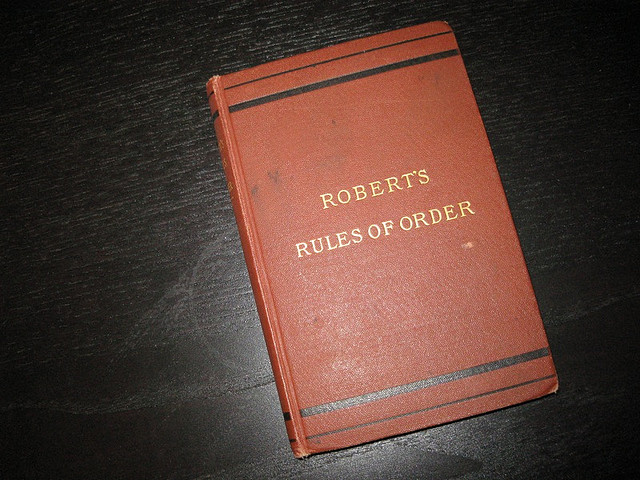
The good news is, it doesn’t have to be this way. Let us be clear: there is no legal requirement that boards of education in Nebraska follow Robert’s Rules or any other formal system of parliamentary procedure.

Who Is Robert?

In 1876 Brigadier General Henry Martyn Robert wrote the book ROBERT’S RULES OF ORDER after he had failed miserably in leading a meeting at his church.  Robert set out to provide a few rules by which to conduct an efficient meeting, but the project soon took on a life of its own, as questions arose and were answered. The book is over 600 pages long with ROBERT’S RULES OF ORDER NEWLY REVISED IN BRIEF running 200 pages.

And that is the problem. The Rules are complex, and they must be thoroughly understood to be effective. And unless everyone—board members, administrators and patrons—understands the Rules, a self-appointed parliamentarian exerts disproportionate and all too often unhealthy control over the proceedings. Not to mention, public perception of being sneaky or using procedural rules to create confusion is often the impetus of Open Meetings Act complaints to the Attorney General.

What is Required by Nebraska Law?

Happily, Nebraska does not require boards of education to follow Robert’s Rules of Order or any formal system of parliamentary procedure. Instead the Open Meetings Act has a few straightforward but non-negotiable requirements.

1) Every Item the Board Considers Must be on the Agenda

The agenda rule in Nebraska is pretty simple: at least 24 hours before the meeting, any item which will be discussed by the board must be placed on the agenda with enough specificity that an interested member of the public will know that the board will discuss it. That is it. Boards that do nothing other than fully comply with Nebraska law will have very straightforward, uncomplicated agendas, albeit with longer descriptions of each item than most boards currently use.

Robert’s Rules have all kinds of funky rules for the construction of an agenda. For one popular example, they divide meetings up by things like “consent agendas,” “action items,” “discussion items,” and other types of agenda items are doing so voluntarily. There is no such requirement in Nebraska law, and boards should be careful that the use of those divided agendas (especially “consent agendas”) does not lead to insufficient descriptions required of all agenda items according to the Open Meetings Act.

We discourage boards from engaging in any of this complexity as we believe it can be misleading to the board and to the public. For example, if your board has a motion to approve the agenda and it fails, what happens next?

You cannot add items to the agenda (although the board can table or remove items). If the board has labeled an item as “discussion” does that mean the board can’t take action on the item? Under the Open Meetings Act requirements, the label of the item doesn’t matter; all that matters is the sufficiency of the agenda item and then you can take action. However, all of the formulaic requirements of Robert’s Rules create uncertainty and distraction for the board. It also is very frustrating for patrons.

2) Formal Decisions Must be Made by a Roll Call Vote in Open Session

The second rule for Nebraska public meetings is as simple as the first.

Formal decisions must be made in open session by roll call vote. There is an exception for electing board officers (which can occur by secret ballot) and there are some unique procedures for collective bargaining and other types of legal negotiations. But by and large, boards will not go wrong if they simply make every formal decision in open session with a roll call vote.

Again, Robert’s Rules have all kinds of limitations and traps about motions and voting. The person who makes the motion must vote for it. The board president cannot second a motion. The motion can only be amended with the consent of the person who made it. And on and on it goes. None of that is legally required in Nebraska and again, we find that these sorts of rules make life harder, not easier for boards of education.

What is Best Practice?

We believe that boards work most effectively when they follow a consensus- based decision making model, rather than a rigid parliamentary one.

Board presidents must maintain firm control of a meeting and be willing to tell the long-winded individuals (be they board members or patrons) to stop speaking so the more reticent can get a word in edgewise. But they should not dominate the meeting through procedural rules. Motions should be stated as simply and precisely as possible. If possible, we like the agenda to include sample motions that may be modified at the meeting. This is especially true for closed session. Having a draft motion helps board members to be more focused on what they are being asked to decide and enables them to make changes quickly without having to “start from scratch” on the revised motion.

As the board considers the agenda item, the relevant ideas should be passed around and the pros and cons are discussed by board members. In high functioning boards, open discussion among board members is not viewed as a negative but at the same time, board members do not use discussion to attack the administration, staff, or each other. Legally it does not matter if the discussion occurs before or after the motion, second or amendment. Allow us to blow your minds even further: there is no legal requirement to get a “second” to discuss or vote on an agenda item. What does matter is that the exact wording of the final motion that the board votes on is captured in the minutes. If a general agreement seems to be emerging (this is where good listening and facilitation skills are helpful), the board president can test for consensus by restating the latest version of the idea or proposal to see if everybody agrees. If anyone dissents, the board can return to the discussion to see if the motion can be modified to make it acceptable to everyone. If there is no consensus emerging, boards may want to consider deferring the matter to a later meeting. There is no requirement that the board jump through any complicated hoops – a simple motion to table the item is sufficient.

Last Point: Check Your Policies

Every board member and educator should check their local policies on this issue. Some boards have, unwisely in our opinion, adopted policies that state the board will follow Robert’s Rules of Order or some other type of procedural process. Our best advice is that boards rescind that policy or at least remove any restrictions which interfere with the otherwise very simple requirements of the Open Meetings Act. It should only be by choice that board members must educate themselves on formal parliamentary procedure and agree to comply with the byzantine rules.

Conclusion

We believe that Robert’s Rules is out of sync with today’s norms about how people relate to each other and get things done. The modern model is consensus and collaboration instead of more formal patterns of decision-making from past centuries. Although the Nebraska Open Meetings Act does require boards the follow certain procedures, the law is vastly easier to comply with when boards do not hitch their compliance to 600 pages of parliamentary procedure rules.

If you have questions about board operations or any other education law issue, contact your school’s attorney or Karen, Steve, Bobby or Tim.

Wellness Update: Smart Snacks, Fundraisers, and the USDA

The Nebraska Department of Education has released its state specific rules in compliance with the Healthy, Hunger-Free Kids Act of 2010. All boards must fully comply with the requirements of the final rule by June 30, 2017. The USDA has released a new requirement that all boards must have a Charged Meal Policy in place by July 1st , 2017. KSB Policy Service Subscribers will receive policy options on this new requirement in our School Meal Policy, but we’ll discuss it here since it’s in the Wellness Wheelhouse (trademark pending).

The Healthy, Hunger-Free Kids Act

The new federal regulations focus on higher nutrition standards, more physical activity, and more community involvement. One question not answered by the federal regulations was whether or not food sold during fundraisers was exempt from the new wellness standards. The regulations leave that decision to the state education agencies.  NDE has decided not to issue an exemption. This means that all fundraiser items sold during the school day must follow the Smart Snacks in School nutrition standards provided by the USDA.

Before you deliver this news to your school support groups and concessions stand operators, this only applies during the school day. Concession stands at student events and after-hours fundraisers are still permitted to stock delicious food items with little or no nutritional value. Even during the school day, fundraising items sold in bulk intended be consumed at home (e.g., tubs of cookie dough) are not subject to the Smart Snacks standard.

Of course individual schools are welcome to adopt a more stringent standard. Examples of policy language are available that offer the full “Carrots & Celery” policy, which bans birthday cupcakes, celebration snacks brought by parents, and general happiness. NDE has posted a webinar complete with sample policy wording, which can be found here. If you are a KSB Policy Service subscriber, we will be sending you a policy consistent with our philosophy which will give schools the maximum flexibility while still complying with the new legal requirements. Any board that would like a more robust and restrictive policy can contact us, and we would be happy to help you craft a custom policy.

USDA Charged Meal Policy Requirement

The new USDA requirement states that boards must have a published policy that details what the school will do in the event a student lacks funds to purchase a meal, has not brought a meal, and is not enrolled in a free meal program (AKA a “Charged Meal Policy”). The USDA does not dictate the policy specifics, only that each board have a published policy, even if their state has not created one. In our experience, every district has a practice on what happens when students don’t have enough money in their school meal accounts. This regulation now requires that this practice be written out in policy and approved by the board.

If you have additional questions about compliance with the Wellness Standards, or the new Charged Meal policy requirements, you should consult with your school district’s attorney, or call Karen, Steve, Bobby, or Tim.

Breaking: Transgender Update

There has been a significant change in the status of the pending transgender

case before the Supreme Court.

The Trump Administration Moved Away from Obama Administration

Positions, and the Supreme Court Took Notice. As we explained in our

last update, the Departments of Education and Justice have withdrawn the

“Dear Colleague Letter” which required schools to treat students consistent

with their gender identity. This change in position for the federal government

has now affected the G.G. v. Gloucester County case which was scheduled to

begin argument before the Supreme Court this month. We had hoped it

would provide clarity on this issue, but instead the questions presented will

be delayed even further.

The Court has “vacated” the decision of the Fourth Circuit and sent the case

back down to the lower courts for further deliberation after the federal

agencies withdrew the transgender guidance issued under the Obama

Administration. As you may recall, the Fourth Circuit’s position was that

courts should listed to the Obama Administration’s Department of Education

and Department of Justice when they interpreted Title IX regulations about

rights of transgender students. They had previously said schools should

defer to students’ gender identity. Because that guidance has changed, it

remains unclear how this case will resolve.

Transgender Issues Remain Unsettled. These events make one thing

obvious: the law in this area remains unsettled, and the federal

government’s position is in flux. Interestingly, both sides did tell the

Supreme Court that the questions at issue were still ripe for adjudication.

However, this decision signals that the Court likely believes the Trump

Administration should have the opportunity to participate at the lower court

level if it chooses to do so.

There are several other transgender cases pending at various levels of the

federal court system which could now come into play down the road. Some

of those cases have found for the student and others for the school. So, it is

possible one of those cases will work its way up to the Supreme Court, but

that likely will not be this year.

What are the next steps for Nebraska boards of education? As

frustrating as this is, we continue to believe that the best decision is to wait

for further developments in the law. We believe boards can continue

operating under their antidiscrimination policies as written, without

specifically including “gender identity.” Our best practical advice is for

boards to permit their administrators to work with families one-on- one with

accommodation requests. At its core, Title IX expects individualized

consideration of student needs, so avoiding the sweeping policy decisions

makes sense to us.

A Note on Public Statements. We anticipate that agencies like the ACLU

will continue to take the position that students are protected from

discrimination and should be accommodated on the basis of their gender

identity. As board members and administrators, you do have the right to

form your own personal opinions, and you have First Amendment rights to

free expression. However, as school attorneys we believe that our job in

defending your board’s decisions could be more difficult if administrators and

board members make sweeping public pronouncements about this issue.

We are encouraging board members and administrators keep their own

counsel and refrain from making statements about the issue of transgender

student rights in their official capacities, even as parents, patrons, and

others may have very strong viewpoints on either side of this issue. We

certainly believe personal convictions can and should drive policy in your

community; however, on this particular issue we believe your district will be

in the best position to defend its actions if the discussion of these issues is

focused on the legal questions. Because those remain so unclear, waiting

for additional clarification makes sense to us.

If you have questions or concerns about these or any related issues or are

interested in your board’s policy options, we recommend that you consult

with your school district’s attorney or call Karen, Steve, Bobby, or Tim, our

new attorney here at KSB.

The First Four Weeks: What We Know So Far

During the first month of the Trump presidency, the news headlines have been

filled with things the new president has done and how the country is responding to

those actions. There’s a lot of noise out there, but there were not many changes

of substance for schools. That has changed over the past few days. We have

sorted through the executive orders and other actions to date and want to pass

along this update on the education-related issues which are evolving in Trump’s

administration.

DOJ/DOE Repeal Transgender Guidance. On February 22, the Departments of

Justice and Education (DOJ and DOE) withdrew two prior guidance documents

regarding the rights of transgender students in schools. The more famous of the

two documents, the “Dear Colleague Letter” released in May 2016, is the letter

which definitively stated the enforcement positions of both departments and

prohibited schools from doing things like prohibiting transgender students from

using facilities (like restrooms and locker rooms) consistent with their gender

identity as opposed to their biological sex. Combined with the passage of the

Nebraska School Activity Association policy on participation of transgender

students in school activities, this issue got a lot of attention and news headlines in

Nebraska and nationwide. Now, those guidance documents have been repealed.

You can find the DOJ’s letter repealing the transgender guidance here, and the

DOE’s version here. A general theme of the statements by the DOJ and DOE is

that “there must be due regard for the primary role of the States and local school

districts in establishing education policy.” The agencies have vowed to “more

completely consider the legal issues involved.”

The focus now turns to two issues: first, how the DOJ and DOE will enforce Title IX

with respect to transgender students, and second, what will happen with cases

making their way through the court system in light of the withdrawal of the

guidance document. In particular, the G.G. v. Gloucester County School Board

case is set for argument before the Supreme Court on March 28, 2017. The G.G.

case may still answer some of the legal questions on this issue, but more will

become clear on that in the coming weeks. For now, our sentiment on this issue

remains the same. It’s best to proceed slowly and with caution until there is more

certainty. Schools have always done what’s best for all students and addressed

student needs on a case-by- case basis. We continue to think that approach makes

a lot of sense.

Supreme Court Rules in Fry v. Napoleon. Speaking of the Supreme Court, on

February 22, the Court ruled in the case of Fry v. Napoleon. This case asked an

important question for public schools: if students and parents file a lawsuit under

the American’s with Disabilities Act (ADA) or the Rehabilitation Act (which includes

Section 504) for something like denying a service dog, are they first required to

“exhaust their administrative remedies” by challenging a school’s special education

decision in an administrative hearing prior to going to court. The Court answered,

“no,” the importance of which is best illustrated by the facts of the case.

The Fry’s daughter was diagnosed with cerebral palsy. When she was 5 and

getting ready to enroll in kindergarten, her parents bought her a service dog (a

goldendoodle named Wonder) to assist her at school. The school denied the

request, saying they had staff members and programs which would be able to

assist a young kindergarten student with everything the dog was going to do, like

help the student use the bathroom and pick up things she had dropped.

Under the Individuals with Disabilities Education Act (IDEA), parents are not

allowed to challenge a school’s decisions in court until they first challenge them in

the state’s administrative proceedings. In Nebraska, for example, if a school made

an IEP decision which parents disagreed with, the parents would first have to go

through a hearing in front of a Nebraska Department of Education hearing officer

or some similar process before they went to court. That’s because the IDEA, as

opposed to the other disability protection laws, requires the administrative process

to determine if there was a denial of a “Free Appropriate Public Education” (FAPE)

before lawsuits can be filed. The other discrimination laws, like the ADA and

Rehabilitation Act, don’t have that requirement.

In this case, the Frys skipped the IDEA administrative challenge process and filed

a lawsuit in a Michigan federal court under the ADA and Rehabilitation Act. The

school’s argument was simple: courts can’t decide if the school violated the

student’s rights under the disability laws until the parents challenge the school’s

decision through the administrative process. The school initially won the case, but

yesterday the Supreme Court reversed the lower courts and said the analysis of

whether the administrative exhaustion is required must be made on a case-by-

case basis, considering the substance of the challenge made by the parents.

This is a significant case for schools who may face challenges to their decisions

regarding special education services under the IDEA and other accommodations

made under the ADA and the Rehabilitation Act. While this may not lead to more

complaints, it provides a clearer path forward to analyze the requirements prior to

a lawsuit for both schools and families.

PPACA (aka “Obamacare”) Repeal Process. As business officials across

Nebraska finalize their PPACA reporting forms, there have been several

Congressional hearings on the various aspects of replacing Obamacare and/or

fixing aspects of the federal healthcare laws and markets. This will be an issue to

monitor moving forward due to the decisions made by boards to comply with

Obamacare the last several years. For now, the law remains in effect, but the

Trump Administration continues to promise that an alternative proposal will be

rolled out soon.

ESSA Regulations Delayed and Challenged. Recently, Congressional

Republicans have introduced measures to delay some of the prior administration’s

proposals to implement the Every Student Succeeds Act, which replaces No Child

Left Behind. These include efforts to rescind school accountability and teacher

training regulations.

The Trump administration has also delayed these and other regulations

implementing ESSA. Several sets of regulations were set to go into effect in

January, but the administration delayed their implementation in order to review

them. While they focused primarily on issues which did not immediately impact

schools, the statement by the DOE was important:

In accordance with the memorandum of January 20, 2017, from the

Assistant to the President and Chief of Staff, entitled “Regulatory

Freeze Pending Review,” published in the Federal Register on

January 24, 2017, the Department delays the effective dates of the

following regulations until March 21, 2017: ...Accountability and

State Plans (ESSA Accountability and State Plans)...; Open

Licensing Requirement for Competitive Grant Programs (Open

Licensing)...; and Family Educational Rights and Privacy Act

[FERPA].

Additionally, the administration dispensed of the standard “notice and comment”

functions of rulemaking for these regulations. This may signal that regulations will

go into effect without comments from interested groups—which could be good or

bad for schools.

We will keep you updated on the latest policy initiatives which may be arriving

from Washington or Lincoln. If you have questions about these issues or others,

we recommend that you consult with your school district’s attorney or call Karen,

Steve or Bobby.

Fasten Your Seatbelts! It’s Going to be a Bumpy Ride, But We’ll Give You A Front Row Seat....

Across Nebraska this week, board members will be sworn in to serve their school

districts and ESUs. Next week, Donald J. Trump will be sworn in to serve our

country. What does one have to do with the other? That’s why we’re writing

today.

During President Obama’s administration, we saw some big legislative action.

However, a great deal of federal education and related policy was set by

administrative regulation and guidance. That means the incoming administration

could change directions fairly quickly. On the other hand, the Trump camp was

not very detailed about plans for federal education policy during the campaign and

we don’t know at this point what, exactly, a Trump administration plans to do.

This is precisely why, for several years now and across multiple looming federal

issues, KSB’s position has been simple: schools should sit back, wait for clarity,

and not make decisions on incomplete information when they are not required to

do so. For now, we think boards of education are smart to consider a “wait and

see” approach, with the understanding that educators should be on alert for

emerging information and ready to move quickly on a range of issues if necessary.

Some of the major issues we at KSB will be tracking after the inauguration include

the following:

Wellness and School Meal Regulations. The Department of Agriculture

released new regulations related to student wellness and the school lunch and

breakfast programs earlier this year. According to the Department of Agriculture,

“The final rule expands the requirements to strengthen policies and increase

transparency.” The regulations will require some changes to most school districts’

wellness policies and some changes to practices and public input relating to these

programs. Some schools have begun to make changes to their policies, which is

perfectly acceptable.

We want to emphasize, however, that the deadline is not until June 30, 2017.

Some entities have put out “sample” policies which, in our view, are incredibly

complex and much more onerous than necessary. Of course, your board is

entitled to use such a policy, but we want our policy subscribers to see their range

of options prior to potentially telling the booster club they can’t sell cookies

anymore. If your board wishes to consider a more complex policy, you would be

wise to do so now. You can review a more complex model wellness policy that

was “[t]horougly review by USDA Food and Nutrition Service” and updated to

reflect the USDA Final Rule here. Unlike the safety and security policy package we

rolled out earlier this year, we believe these wellness and food program changes

may land on the list of things the new administration will review early in the term.

As will be the case at the state and federal level, a lot will change and much more

will be known between now and June 30, which is precisely why we continue to

wait to roll out our draft changes to wellness and food program policies.

Fair Labor Standards Act. We’ve been writing about this one for a while. You

can follow along with the series of events relating to the regulatory changes of the

FLSA by looking through our past updates here, here, and here. Most recently,

and most importantly, the regulations increasing the minimum salary

requirements for exempt employees remain blocked by a federal court in Texas.

While an appeal is underway, there have been headlines nationally claiming that

the Trump administration will drop the lawsuit and potentially repeal the

regulations outright. That leaves schools who made changes to account for the

now-delayed increases with a decision: do you go back to the “status quo” or stick

with the changes? Because several clients used these changes as an opportunity

to address other FLSA issues, we do not believe there is a “right” or “wrong”

answer. Instead, from our view as long as your current setup is legal you can

afford to wait a few more weeks to see what the Trump administration will do.

Accommodations for Transgender Students. Last May, the Departments of

Education and Justice released a “Dear Colleague” letter which informed schools

that the Departments believe that schools are legally obligated to honor the

choices of transgender students on issues like restrooms, locker rooms, and

activity participation. The guidance is based on the Education Department's

interpretation of Title IX of the Education Amendments of 1972, which bars

discrimination based on sex in federally funded educational programs. The

Education and Justice Department stated that they “treat a student's gender

identity as the student's sex for purposes of Title IX and its implementing

regulations." The "Dear Colleague" letter concludes, "This means that a school

must not treat a transgender student differently from the way it treats other

students of the same gender identity."

On August 21, a Texas judge issued an injunction which prohibited the

administration from enforcing this transgender guidance nationwide. After that

order was issued, the United States Supreme Court agreed to hear a case related

to the restroom use of a transgender student from the Fourth Circuit, Gloucester

County School Board v. G.G. Earlier this week, the Department of Justice filed an

appeal in the Texas case asking the judge to lift the nationwide block of the

transgender guidance and defer instead to the Supreme Court in the G.G. case.

As we have been saying for a few years now, this issue is far from settled. Taking

strong policy stances on either side of these issues comes with risk and should

only be done knowing all of those risks.

Educational Benefit to Special Education Students. Today, the Supreme

Court heard oral argument in the Endrew F. case. This is the case asking the

Supreme Court to review the level of educational benefit required to provide a

“free appropriate public education” (aka “FAPE”) to students eligible for special

education services. Federal courts are split on this issue, with one side saying you

must only provide “some” benefit and the other saying you must provide

“meaningful” benefit. Nebraska is in the Eighth Circuit, which only requires

“some” benefit. This case will cement and reaffirm the current lower standard, or

it will increase the required level of benefit Nebraska schools must provide. If the

Court elects the higher standard, that probably means training for your staff, more

parental challenges, and increased costs. That makes this a big case which we’ll

be following closely.

Supreme Court Vacancy. Given Endrew F., G.G., and other important cases in

front of the Court this term, it is almost certain that one of the administration’s

first priorities will be to name a Supreme Court nominee to fill the seat of Justice

Antonin Scalia, who passed away last February. It is much less clear whether

Justice Scalia’s seat will be filled before oral argument is heard in the G.G. case,

and the Endrew F. case was heard with only 8 Justices today. The timing of these

oral arguments and the seating of a new Justice will impact one another.

Supreme Court rules permit re-argument in cases when a new Justice is sworn in

pending a decision from the Court.

Guidance on Seclusion and Restraint. On December 28, 2016, the Office for

Civil Rights, a division of the United States Department of Education, released a

Dear Colleague letter regarding the seclusion and restraint of students.

Specifically, OCR asserted that students with disabilities are inappropriately

subjected to seclusion and restraint more often than non-disabled students, and

the Department views this disparity as evidence of discrimination by schools

against disabled students. The letter included an extensive question-and- answer

section and a fact sheet that encourages parents to contact the Office for Civil

Rights to report concerns about the use of seclusion and restraint by schools.

The issue of seclusion and restraint is one that will continue to develop over time.

The data does clearly establish that students with disabilities are subjected to

seclusion and restraint more often than typically-developing students, although it

is far less clear that this disparity is the result of schools doing something wrong.

The Every Student Succeeds Act (“ESSA”—which replaces No Child Left Behind)

requires state departments of education to develop plans that include statewide

strategies to reduce bullying and harassment, restraint and seclusion, and

suspensions and expulsions. These plans were initially due to the federal

education department in March or July 2017, but on November 28 th , the

department released new regulations that pushed the submission dates to April or

September. Exactly what states will be required to submit could change under the

new administration and it is also possible that the deadline for these state plans

will be pushed back yet again.

For now, we think every educator should review the current seclusion and restraint

policy that has been adopted by their board of education, and they should comply

with that policy with fidelity. Everyone who works with students with disabilities

should be mindful that these students shouldn’t be restrained or secluded

inappropriately, and educational teams should work hard to craft behavior

intervention plans that provide students with positive behavioral supports. We do

not recommend making major changes to otherwise lawful seclusion and restraint

practices based on this last-minute Dear Colleague letter from the outgoing

administration, because the next administration could take a completely different

approach to this issue. We do think that educators should watch this issue closely.

In particular, we will be tracking the relevant elements of the plan the Nebraska

Department of Education is crafting for submission to the federal agency.

PPACA (aka, “Obamacare”). Finally, no news cycle will go by in the next

several weeks without discussion of Congress’s possible actions relating to

Obamacare. If you’ve followed this issue at all recently, you’ve heard it’s possible

for an “outright repeal,” “partial repeal,” “repeal and replace,” and most recently,

“repeal and delay”—where Congress would repeal the law with a delayed timeline

for the various requirements to be lifted while replacements are crafted. It’s also

possible the repeal will happen piecemeal over the next several weeks, months, or

even years.

The practical reality of this uncertainty is that we have no idea how long the

onerous requirements of the law will remain in place. Business officials must

continue preparing the required reporting documents while the law remains in

effect, for example. Even if you assume the law will be repealed, boards will face

difficult decisions. Many schools and ESUs have offered classified staff members

with access to health insurance or increased insurance benefits in the last year. If

the law is repealed, will boards eliminate that benefit? Will employees who have

purchased insurance on healthcare.gov now clamber for the school to offer

insurance for purchase? Will all of the other employers in local communities revert

to their prior benefit practices (which will affect school employees whose spouses’

insurance options change)? Not to sound too redundant, but all these unanswered

questions mean it’s a good time to be patient and wait to see what your

continuing obligations, if any, will be under federal health care law.

Conclusion. As we have consistently said with many of these requirements over

the past several years, it is best not to act prior to having all the information

needed to make the best decision possible for your school or ESU. We will track

all federal and state law actions diligently on behalf of our clients and educational

entities throughout the state. We will continue to provide these updates via social

media and through direct e-mails to any school, ESU, administrator, or board

member who would like to receive them. We also know other legal experts,

professional groups (like NCSA and NSBA) and publications (such as Education

Week), will be monitoring these changes. Opinions on certain issues,

requirements, and the urgency to act may vary, so your board should secure

information from sources you trust. Because we will provide our updates free of

charge to anyone interested in them (and will be posting them to our website

regularly), please just let us know if others in your school or ESU would like to

receive them directly via e-mail.

If you are a policy service subscriber, you will receive updated policies from KSB

as they are required along with explanations of the changes which will highlight

areas where your board must make decisions. If you are not a subscriber, you will

continue to receive these updates free of charge. If you do not wish to receive

these updates via e-mail, please reply to any of the e-mails you receive

transmitting the update, and we will be happy to remove you from the list. If you

have questions about these issues or others, we recommend that you consult with

your school district’s attorney or call Karen, Steve or Bobby. In the meantime,

keep those seatbelts buckled and watch things unfold!

Substantial Likelihood of Injury

In 2016, a 15 year old special education student wrote his own rap lyrics in

a school journal. Salem City Bd. Of Educ., EDS 01159-16 (2016). He wrote

“U better dip like a chip because I got a new gun with 2 clips I can’t wait to

use it better yet shoot it…” The student did not give the lyrics to anyone or

perform them. The student had previously been warned that discussing

shooting a gun is not appropriate at school. There was no written policy

prohibiting students from making gun references. The student informed the

Superintendent that he does not own a gun and no one in his household

owns a gun. The Superintendent recommended suspending the student and

placing him at an alternative school. The police were contacted but no

charges were filed. The Board held a hearing where it confirmed the

Superintendent’s recommendation of suspension and alternate placement for

making terroristic threats. The student’s Case Manager testified that the

Child Study team had not been consulted about disciplining the student. The

parent testified that when he spoke to the Superintendent, he felt that the

decision to place the student in an alternate placement had already been

made.

Under the Individuals with Disabilities Education Act (“IDEA”), a school

district can place a student in an alternative placement without determining

whether the behavior is a manifestation of the students disability for 45 days

or less if the student: brings a weapon to school; inflicts serious bodily injury

on someone while at school; or knowingly has, uses, sells, or solicits the sale

of a controlled substance while at school, on school premises, or at a school

function. If the student’s current placement is substantially likely to result in

an injury then the district can request an expedited due-process hearing. A

hearing officer may return the student to their current placement or order an

alternate placement for 45 days or less if the hearing officer determines that

the current placement is substantially likely to result in injury.

The Department of Education held that the District provided no evidence that

the student made terroristic threats since the lyrics were not aimed at

anyone and were not shared with anyone. The District did not determine

whether the behavior was a manifestation of his disability as the Child Study

team was not consulted. Without determining that, the District cannot

remove the student to an alternate placement since the student did not

bring a weapon to school or inflict serious bodily injury (see above

paragraph). The Department of Education also held that the Board did not

show a substantial likelihood of injury in his current placement. The

Department then noted that there was no proof of physical violence which is

sufficient for finding a substantial likelihood of injury. It was also noted that

threats of violence are unlikely to result in a substantial likelihood of injury

without physical violence. Since the school does not have a policy prohibiting

references to guns, the Department of Education held that the student had

not violated the school’s policy. The Board could not remove the student to

an alternate placement but the issue of whether the student’s due process

rights had been violated was not determined.

Before a school district even considers whether the current placement is

substantially likely to cause injury, the district should determine whether the

student’s behavior is a manifestation of their disability. If it is determined

that the behavior was a manifestation of their disability, then the Board can

consider whether the current placement is substantially likely to cause

injury. Vague statements relating to violence are generally not sufficient.

Even threats directed at someone may not be sufficient if there is not also

physical violence. The IDEA and regulations do not includes factors to

consider so the Board must use its judgment and previous cases in making

the determination.

If you have questions about how to determine whether an alternate

placement is justified, we recommend that you consult with your school

district’s attorney or call Karen, Steve or Bobby.

IDEA Parents Visiting the School

Sometimes parents of students with disabilities would like to visit the school

and observe their children. The Individuals with Disabilities Education Act

(“IDEA”) expanded parent’s roles in the identification, evaluation, and

placement of their child. The IDEA does not, however, give parents a general

entitlement to observe their children at the school, although school districts

and parents are encouraged to work together and there may be some

circumstances where access may need to be provided. Generally, the

parents are still able to be full and equal participants in developing the

Individualized Education Program (“IEP”) without observation, except in

those circumstances where access may need to be provided such as when

the right to an independent educational evaluation has been invoked.

There has been a focus on what other ways the parents are being included in

their child’s education to determine whether the parent should have been

allowed to observe. In Bd. Of Ed. Of the Carmel Central School Dist., 48

IDELR 144 (2007), a special education student’s parent received services

through the IDEA and requested to observe the student for a full school day

in order to prepare for their annual review. The school denied the request.

The parent then requested to observe two classes back to back, in order to

both observe the classes and the student walking between classes. The

school denied this request but offered the opportunity to observe one class

of the school’s choice. A written test was given during the class so the

parent felt that the observation was useless.

After the annual review, the parent filed a due process complaint stating that

she needed to observe the student to evaluate the environment, student’s

skills, and safety. The hearing officer found that there was no statutory or

regulatory right to observe the student in class and that the school had

discretion in whether to grant observation. The hearing officer did direct the

school to allow the parent to observe one class period where there is

instruction however.

The parent appealed the decision to the New York State Educational Agency

stating that the restrictions on her observation by the hearing officer are a

procedural violation of IDEA. The Agency held that parents must be given an

opportunity to participate in developing their student’s IEP, but that does not

give a general entitlement to observe the student. The Agency also stated

that schools and parents should work together in order to meet their needs.

The parent was generally able to have her questions answered and received

regular progress and report cards so her ability to participate in developing

the student’s IEP was not significantly hindered.

Hearing officers and educational agencies have stated many times that a

parent does not have an unlimited right to observe their child in school. See

In re: Student with a Disability, 43 IDELR 214 (2005); Letter to

Mamas, 42 IDELR 10 (2004). Parents do have the right to be provided with

an opportunity to meaningfully participate in identification, evaluation and

educational placement of their child however. Districts and parents are then

encouraged to work together to meet both of their needs which may include

allowing observations.

If a District would like to deny a parent of a special education student’s

request to observe the student, the District should consider in what other

ways the parent is able to participate in the student’s education. The parent

should still have an opportunity to meaningfully participate in developing the

student’s IEP, and educational plan. The District should also consider how

they could work with the parents to meet both their needs.

Another concern about refusing to allow parents to observe is that the

parent may claim that the denial is in retaliation for the parent’s advocacy.

One of the best defenses to this claim would be to consistently enforce the

district’s visitor policy. This policy should limit the number and duration of

visits as well as be widely publicized.

If you have questions regarding parental observations, we recommend that

you consult with your school district’s attorney or call Karen, Steve or

Bobby.

When Overtime Can be Offset

Nobody likes paying overtime but everybody likes receiving overtime.

Recently, a company tried to avoid paying overtime by offsetting it with paid

lunch breaks in Smiley v. E.I. DuPont De Nemours & Co., 839 F.3d 325 (3 rd

Cir. 2016). Their employees were required to be on site before and after

their shift for between 30 and 60 unpaid minutes per day. The company

provided paid breaks throughout the day which exceeded the amount of the

unpaid time at the beginning and end of the day. These paid breaks were

included in their compensation when calculating their regular rate of pay.

The Fair Labor Standards Act (“FLSA”) requires that employers pay their

employees for all hours worked. Lunch breaks may be paid but are not

required to be. Paid lunch breaks may be considered hours worked,

depending on whether the parties agreed to treat them as such.

Compensation cannot offset overtime when there is already an agreement to

treat noncompensable time as hours worked and the compensation is

included in the regular rate of pay.

The employees in Smiley sued the employer (“DuPont”) for failing to pay the

employees overtime for the time spent before and after their shift. The

employees worked four 12 hour shifts per week which included one paid 30

minute lunch break and two nonconsecutive 30 minute breaks. The 12 hour

shift did not include the 30-60 minutes that employees were required to

spend before and after their shift changing in and out of their uniforms and

updating the next shift. This extra unpaid time would be overtime since it

would be in excess of 40 hours worked per week. DuPont claimed that

because it was not required to provide compensation for meal breaks, the

compensation from meal breaks could be used to offset the unpaid overtime.

The court held that all monetary compensation, except for the statutory

exclusions, is included in calculating the regular rate of pay. Compensation

that has already been paid to an employee may only be used to offset

overtime when that compensation is statutorily excluded from being used to

calculate the regular rate of pay. Meal periods are not included in the

statutory exclusions and thus are included in calculating the regular rate of

pay. The court found that since the meal breaks were included in the regular

rate of pay, the meal breaks could not qualify as extra compensation and

thus could not be used to offset the overtime due.

Three types of compensation are allowed to offset overtime. The FLSA allows

compensation to offset overtime when: (1) the employee has been paid at a

premium rate for working more than 8 hours in a day, more than the

maximum workweek under the FLSA or more than their regular working

hours; (2) when the employee receives a premium rate of not less than 1 ½

times their regular rate for working Saturdays, Sundays, holidays or regular

days of rest; and (3) when the employee receives a premium rate of not less

than 1 ½ times their regular compensation for work outside the regular

workday or workweek per their employment contract or collective bargaining

agreement.

In order to offset overtime, the employer must at least already be paying

the employee at a premium rate. This way, a premium rate is offsetting a

premium rate. If the paid break were allowed to offset overtime, it would be

counted twice. The first time as regular compensation for hours worked, and

the second time as statutorily required compensation for other hours of

work. Also, the paid break compensation is already owed to the employee so

crediting the money would be withholding compensation that the employee

is entitled to by statute.

It can be difficult to determine when overtime needs to be paid and when it

can be offset. If you are paying an employee for their time, it probably

counts against your 40 hours for the week even if you were not required to

pay them for the time. Overtime can only be offset when it meets one of

those three statutory exclusions. If an employee is not exempt and you pay

them for more than 40 hours a week, the amount of time over 40 hours will

need to be compensated as overtime unless it meets one of the exclusions.

Teachers are exempt from overtime but this may apply to some of your

other employees.

If you have questions about when overtime needs to be paid or can be

offset, we recommend that you consult with your school district’s attorney or

call Karen, Steve or Bobby.

Who Needs a Copy of the IEP?

Special education attorneys frequently warn school staff about the legal

problems which arise when schools fail to keep student information

confidential. However, schools can also run into legal trouble if they keep a

student’s IEP too confidential. A good example of this issue is Prince

George’s County Public Schools, 66 IDELR 203 (MD SEA 2015).

In this case, a school district in Maryland was found to have violated the

IDEA when it failed to provide a bus driver with a complete copy of the IEP

of a student with autism. The IEP required several bus accommodations and

supports. The bus driver was given a “route sheet” which indicated some of

the accommodations required but did not list every accommodation or

support. The school had no documentation to prove that the bus driver was

notified about the accommodations or supports that weren’t listed on the

route sheet. The Maryland State Department of Education held that the

school had failed to properly implement the IEP. The Department reasoned

that since the school district is required to ensure that the student receives

the services required by the IEP, so it is also up to the school district to

ensure that every teacher and service provider who is responsible for its

implementations have access to the student’s IEP.

It is school district’s responsibility to ensure every staff member who

implements the IEP has access to the document. This may involve

implementing a procedure to determine who needs a copy of the IEP and

ensuring that those people receive a copy. Many schools rely on an

accommodations checklist similar to the route sheet used in Prince George’s

County. This case should serve as a warning that if schools are providing

something other than the full IEP to staff, that separate document must

include all the accommodations and supports a student is entitled to receive.

If you have questions about how to communicate with staff about special

education students or any other questions, we recommend that you consult

with your school district’s attorney or call Karen, Steve or Bobby.