
We rarely ring alarm bells during a legislative session. The Nebraska education community has excellent legislation trackers that keep you all informed of what the Unicameral is doing. We are making an exception and ringing the alarm about LB 841, which recently advanced out of the education committee. Every member of Nebraska’s education community needs to be aware that LB 841 would dramatically change how special education decisions are made in Nebraska schools. As currently drafted, the bill requires parental consent before ANY change is made to a student’s IEP. This is not required by the IDEA. Nor is it a narrow procedural adjustment. It would affect daily decisions about services, staffing, and student safety. Because of the scope of this proposed change, educators and families should understand what is at stake before the Unicameral takes further action.
LB 841, is a short bill, with a significant impact. In simple terms it requires parental consent before schools can implement any change to a special education student’s IEP.
Think back to your 3 most contentious IEP team decisions, and now imagine how they play out under a system where you can’t implement ANY changes without consent. If a district wants to change an IEP and a parent disagrees, the district would have to sue the parent in an administrative hearing to make the change. In practice, this means even routine decisions could require litigation if a parent is unreasonable or intractable. For example:
Reducing speech services from 20 minutes to 15 minutes per week, based on documented progress;
Increasing paraprofessional support during a transition from elementary to middle school; or
Moving a violent student from the general education classroom to the resource room to keep peers safe.
Under LB 841, any of these decisions could be blocked by a single angry or frustrated parent. Schools would then be forced to either ignore the expertise of their educators or pay lawyers to go to a hearing to fight for the team’s decision.
This would be a huge change in how special education operates in Nebraska. Current law requires parental consent at key points, such as initial evaluations, initial services, and the decision to decline services. Outside of those circumstances, schools are responsible for making educational decisions necessary to provide a free appropriate public education. After all, parents already have the right to meaningfully participate in IEP meetings and the IEP team must consider parental input as part of the team’s decision-making process. LB 841 would expand consent requirements far beyond what is required by federal law, effectively giving parents veto power over every single educational decision made by educational experts for special education students.
A few other states have enacted laws like LB 841 with disastrous results. Florida offers a cautionary tale. Florida law requires parental consent before a student can be placed in a level 3 behavior program. In Florida (as in Nebraska), parental rights transfer to students when they turn 18. The Florida law requiring parental consent, like that proposed in LB 841, meant that the 19-year old student who committed the tragic school shooting at Marjory Stoneman Douglas High School that killed 17 students and staff had the right to refuse (and had refused) the school district’s attempts to place him in a specialized program to address his mental health needs.
This tragic example underscores the broader concern with LB 841. It will hamstring school administrators who are constantly required to nimbly and quickly address significant threats to the health and safety of the school community. Under LB 841, if a parent disagrees with a school’s placement of a violent student in a specialized program, schools will be required to either accept the status quo or file for due process to implement the change.
Proponents of this bill pitched it as a way to promote educational continuity for military families. That is a worthwhile goal, but one that can be addressed without completely restructuring how every special education decision in the state of Nebraska gets made. LB 841 is not limited to military families, and its requirements would apply to every IEP decision for every special education student in every school district across the state.
Current law already requires meaningful parental participation and provides parents with multiple avenues to challenge IEP decisions. These include the right to request mediation, file a state complaint, or initiate due process. At the same time, schools remain legally responsible for ensuring that each special education student receives a free appropriate public education. LB 841 would shift that balance by requiring schools to initiate legal action before implementing changes the school thinks are necessary. Schools already get sued for doing exactly what a parent asks if it’s not educationally appropriate for the child. Under LB 841, schools could also be sued for not suing the family soon enough.
The only thing that LB 841 will accomplish for sure is to provide more work for trial lawyers. New Hampshire, Kansas, and Virginia have state laws that give parents the right to veto some IEP decisions. Compare the number of due process cases litigated in those states to the number currently litigated in Nebraska:
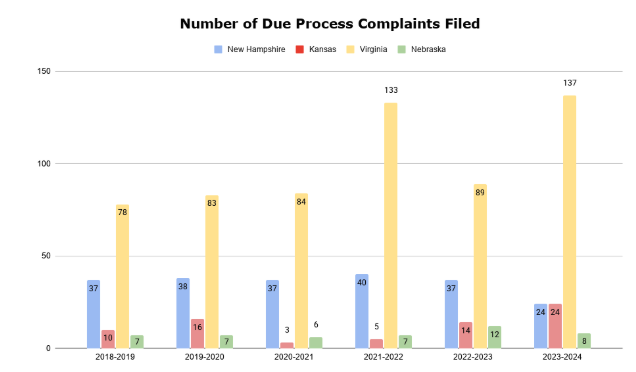
Image Credit: Underlying data is taken from https://cadreworks.org/national-state-dr-data-dashboard.
LB 841 would go even further than the laws in Virginia, New Hampshire, and Kansas. If LB 841 becomes law, Nebraska schools can expect increased legal costs and additional demands on staff time. Schools will have to pay school lawyers like us to litigate many, many more cases. And that cost will not be part of your special education budget - the cost will be passed directly on to your local taxpayers. If you have been part of a due process proceeding, you know that not only is it expensive in terms of cost; it is also expensive in the long-term toll it puts on staff, district, and parental dynamics.
As school leaders, your voice matters in this conversation. LB 841 would directly impact your ability to serve students, maintain safe learning environments, and manage limited resources. These impacts extend beyond special education and will impact the broader school community. No one wins in a system that rewards the most combative, unreasonable, or misguided parents at the expense of the educational services provided for all other students. We encourage you to contact your senators and share how this bill would affect your district’s operations, staff, and students. Here at KSB, we have drafted some talking points to facilitate a conversation with your senator, and we can provide them to you free of charge upon request. Just shoot us an email at ksb@ksbschoollaw.com.