Spring Professional Development: Two Easy Options

If you’re starting to think about spring professional development and wondering how to fit one more thing into an already full calendar, we can help.  We offer two professional development options that respect teachers’ time and focus on the decisions they actually make every day.

Option 1: On-Demand Video Series

Our new on-demand series is designed for maximum flexibility and minimal disruption:

What School Attorneys Wish Teachers Knew: Legal Perspectives on Everyday School Decisions

  • 10 short videos

  • Each video runs 10–12 minutes

  • Includes discussion questions if you want teachers to debrief with others

Option 2: In-Person Staff Inservice

For schools that prefer live professional learning, we offer in-person staff inservice sessions tailored to your needs.  These sessions focus on real scenarios educators face, provide clear guidance, and leave room for questions that usually start with, “What if…”

If you’re planning spring PD, we’re happy to talk through what would work best for your staff.  Shoot us an email at ksb@ksbschoollaw.com to discuss options and cost.

New 1099 Thresholds: What to Know Now

Is that the chill of a winter storm we feel coming? Or is it just the frigid heart of tax season bearing down on us all? 

One quick update to keep on your radar: 1099 reporting thresholds.

Beginning with payments made after December 31, 2025, the IRS has increased the reporting threshold for Form 1099-MISC and Form 1099-NEC:

  • Old threshold: $600

  • New threshold: $2,000

This change will be indexed for inflation after 2026, meaning the threshold will almost certainly continue to adjust in future years.

What does this mean for schools? While this won’t impact reporting for the 2025 tax year, it’s a great time to start planning ahead—especially if your school regularly works with independent contractors, consultants, or other non-employees.  As a reminder, we recommend routinely seeking updated W-9s from those individuals.  Lastly, the IRS published instructions regarding these form updates on December 23, 2025.  They are available here

If you run into any questions this tax season, our email is ready at ksb@ksbschoollaw.com 

Cold Weather, Hot FMLA Questions

January brings snow days, icy sidewalks, and that perennial winter question: Does this count as FMLA? Yes, it’s mostly lawyers who lose sleep over it. The good news: the Department of Labor has finally cleared the fog—so, for once, attorneys can rest easy, and you can too, just in time for the next weather closure. (P.S. If you need a quick refresher on FMLA leave, before diving into this blog, click here. We also have FMLA training videos available for purchase here.) 

According to the recent letter from the Department of Labor, when faced with a school closure, determining how to count FMLA depends on the type of FMLA leave the employee is using. 

Scenario 1: Employee Is Using FMLA for Less Than a Full Week

Intermittent leave is only available when medically necessary or if agreed to by the employer.  If an employee is approved for intermittent or reduced-schedule FMLA leave, and the school closes for one or more days during that week, and the employee is no longer expected to report to work during the closure, that time does not count against the employee’s leave entitlement. 

  • Example: A teacher takes FMLA leave every Friday to care for a parent who has a serious health condition. If the school is closed on Friday due to icy conditions, the day does not count against the employee’s FMLA entitlement because the employee was not required to report to work.

Scenario 2: Employee Is Using FMLA for a Full Workweek

If an employee is on continuous FMLA leave for the entire workweek (which is the default approach), and the school closes for less than a week, then the entire week still counts as one full week of FMLA leave. This means the closure does not reduce the amount of FMLA leave used.  It’s still 1/12 available FMLA leave weeks.

  • Example: A teacher is taking bonding time leave after the birth of a child for the next 12 weeks, and the school is closed on Wednesday that week due to snow. Even though the employee is not required to report to work, the employee still uses a full week of FMLA leave. 

The letter clarifies the following do not impact how FMLA leave is counted: 

  • Whether the closure was planned or unplanned.

  • The reason for the closure (weather, utilities, emergencies, etc.).

  • Whether the school later schedules a “make-up” day (an employee’s need for FMLA leave on a make-up day is evaluated independently).

Here’s to clear skies, calm forecasts, and fewer leave questions ahead. But as always, if those questions arise, drop us a message at ksb@ksbschoollaw.com

Before Hotmail Was Hot: FERPA’s Pre-Email Predicament

FERPA debuted in the ’70s—an age of rotary phones, typewriters, manila folders—not exactly the dawn of digital communication. Because of that, FERPA’s original framework didn’t contemplate the advent and rise of Hotmail in 1996 (side note: if you still have your Hotmail account, impressive). Since that time, schools and courts have had to figure out how email communication (and DMs on Facebook) intersects with FERPA obligations. 

Under FERPA, an education record is any record that (1) directly relates to a student, and (2) is maintained by the school district. 34 C.F.R. § 99.3. Back in the day, the concept of an education record was simple; it was the hard copies of information that the school locked away in a student’s file in its filing cabinet. 

Questions in 2025 are different.  With email, when does an email that includes a student’s name or school email address begin to relate to that student directly? At what point does a district “maintain” that record? As recently as April 2025, the Student Privacy Policy Office, the federal office tasked with FERPA compliance, recognized that the Department has not “issued any subsequent formal guidance or regulations that specifically addresses the applicability of FERPA to emails.” Letter to Monogue. However, a recent case out of Nevada sheds some helpful light on this very issue.

In the case Clark Cty. Sch. Dist. v. Eighth Judicial Dist. Court, No. 89127, 2025 Nev. LEXIS 66 (Nov. 26, 2025), the court looked at whether emails that are broadly stored in a district’s Google Workspace are education records. Even assuming an email “relates” to a student, the court reasoned that emails may constitute education records, but to be an education record, “the email relating to the student must be deliberately stored by the records custodian as part of that student's records.” 

The word “deliberate” aligns with the historic understanding of what it means to “maintain” a record.  It means that there is an intentional choice to “maintain” the email, as defined by policy.  Emails that exist within the school’s email system lack that intentionality and, according to the court, were not “maintained”. The court further emphasized that just because an email mentions a student, that does not necessarily mean the email “directly relate[s] to and bear a close connection to the student.”

Now, even though this opinion is out of Nevada, districts in other states can walk away with a few important lessons from it.

  1. Review your district’s policy. The court, in part of its reasoning, looked to the district’s definition of education record to support its finding that emails sent in the ordinary course of business were not automatically education records.  Nowadays, there are all kinds of records (i.e., attendance and discipline file, grade books, student support services folder, etc.). Your policy should focus on what it means to “maintain” a record, rather than focusing on the type of record. 

  2. Routine storage in email servers/databases is not the same as intentional maintenance, assuming your policy defines maintain appropriately. It may be helpful to chat with your tech person to understand better the life of an email in your district’s digital domain.  Clarify with staff what it means to “maintain” records based on your policy. 

  3. Emails CAN be education records, even if not specifically identified in your district’s policy. Whether an email is an education record comes down to that fundamental definition: it must (1) directly relate to the student and (2) be maintained. There may be instances where an email (for example, an email sent by an administrator documenting a disciplinary incident and saved in a student’s disciplinary file) is an education record. 

As always, if you have questions, email us at ksb@ksbschoollaw.com, and we may or may not promise that your email will become part of your KSB education record. 

PPACA Reporting 2025: The “Most Wonderful Time of the Year” for… Paperwork?

Just as the holiday season brings its annual flurry of festivities, so too does the other seasonal tradition you know well: PPACA reporting.  Administrators--if your business officials have attended the PPACA reporting workshop before, they also received an email from Shari, but you should forward this on to them just in case.  If you have a new business official, share this like it’s hot.

While the Patient Protection and Affordable Care Act (PPACA) reporting obligations are more than a decade old, they continue to be a source of confusion, especially for those who only dust off the requirements once a year.  Luckily, the 2025 reporting year brings only modest changes, but still enough updates and reminders to justify a fresh review of your processes before you’re buried under a blizzard of 1095-Cs.

Below is a summary of what school districts need to know as we head into 2025 and an invitation to join us for our annual PPACA webinar, where we’ll walk through everything in detail.

What’s New (or Newly Important) for 2025?

1. Electronic Filing Threshold Remains Low

As of last year, the IRS permanently lowered the electronic filing threshold to 10 forms total across all information returns combined.  That means nearly every school district will be required to file 1094-C/1095-C forms electronically.  Now is the time to double-check with your accounting software provider regarding end of the year trainings and verify that your login information works for the IRS AIR system.  

2. Continued Enforcement of Good-Faith Relief Expiration

The IRS has not reinstated good-faith penalty relief.  This means errors in coding or late submissions can result in significant penalties.  Because the IRS is increasingly using automated matching systems to identify discrepancies, accuracy matters more than ever.

3. Affordability Percentage

In 2025, the PPACA affordability threshold is 9.02% of household income.  The IRS recently released the 2026 threshold which is 9.96%.  School districts should review employee premium contributions to confirm compliance.  In the webinar, we’ll explain how these thresholds apply to plans like schools and ESUs have in place, where the insurance year changes over in the middle of the calendar year.

Join Us: Annual PPACA Update & Reporting Webinar

Just as holiday decorations reappear each year, so does PPACA reporting season.  To help ease the process, Bobby and Sara will once again host the Annual PPACA Webinar. We will cover annual reporting requirements, common mistakes we see our clients make annually, a legal update for 2025, and what to look for in 2026.

Date and Time: Wednesday, December 17, 2025 from 9:00-12:00

Where: The webinar will be conducted via Zoom, and all participants will be able to ask questions during and after the presentation.  All registrants will receive a copy of the slides, materials used in the webinar, and this year’s version of the instructions and forms, plus IRS documents establishing affordability, reporting deadlines, etc.

Cost: The cost will be $350 per school.

Register here

If you have any questions, please do not hesitate to contact us at ksb@ksbschoollaw.com or 402-804-8000.

What South Dakota Schools Need to Know About the 2026 Election Changes

Beginning January 1, 2026, school district elections in South Dakota will operate under updated laws as a result of the 2025 legislative session and HB 1130.  Under SDCL § 13‑7‑10, districts must hold their annual election the first Tuesday after the first Monday in June or the first Tuesday after the first Monday in November.  In 2026, these dates are June 2, 2026 or November 3, 2026.  This means if you were a district that held annual elections in April you must change your date starting in 2026.  Any district selecting a June election should calendar notice deadlines for publication as they are fast approaching in December.  The Secretary of State recently released the school election calendar timeline here

For a June 2026 election, the vacancy‐notice period requires publication of vacancies no later than December 15–30, 2025 (six months before).  Additionally, the January board meeting is the deadline for districts to establish an election date.  Beyond scheduling and notices, districts must also ensure proper training and oversight of the election process for each election.  Under § 12‑15‑7 (which applies to schools because of § 12-1-1) the school business manager is required to convene the precinct superintendents at a convenient time and place prior to each election to instruct them on election laws and duties.  The training materials from the Office of the Secretary of State reinforce that the person in charge of the election should conduct training with assistance of the school’s legal counsel.  As you prepare to enter election season, coordinate with your school attorney what that election training may look like - either in person or via Zoom.  (We are also considering an on demand option so please reach out if there is interest in such a training.)

If you have any questions as you review the new laws regarding elections or need a school board resolution to set your election date, please do not hesitate to contact us at ksb@ksbschoollaw.com.

Turning the Page: Nebraska’s New Library Catalog Law for Schools

Books, we love them!  School libraries, our favorite!  The work required by LB 390?  Not so much.  The Unicameral passed LB 390 in 2025 which requires school boards to adopt a policy relating to parent, guardian, or educational decisionmaker (the law calls them all “parents”) access to certain school library information.  This bill now lives as law at Neb. Rev. Stat. 79-533.04.  This law may not sound like a page-turner, but trust us, this one’s got plot twists.

What’s Required?

Before school starts in fall 2026, every Nebraska school district will need to adopt a Board Policy that does two key things:

  1. Requires the creation of a catalog of all books in the school district’s library, organized by school building.  This catalog must be accessible to parents.

  2. Provide the “opportunity” for a parent of a student to be notified when the student checks out a book, including the book’s title, author, and due date.

Sounds simple? Well, like most new legislation, the details matter yet there aren’t enough.

Paper or Pixels — Your Choice

Good news: The law doesn’t demand anything fancy.  Your “catalog” doesn’t have to sparkle online, and a paper binder would do, as long as it’s accessible to parents.  That said - the vast majority of schools use digital catalogue systems already so it may be simple to allow parent access.  Similarly, the “notification” can be an email, push notification from an app, or via a website. 

Defining “Books” 

The law only applies to “books” in the school’s library.  That means traditional hardbacks and paperbacks are covered.  But what about periodicals?  Or eBooks?  The law simply does not provide any answers.  It clearly uses the word “books” in the catalog and parental notice sections, yet references the broader term “library materials” in another part of the statute.  Legislators are presumed to use different terms intentionally, so we think your initial focus should be on “books.”  

When judges aren’t sure what a word means, they often look at a contemporary dictionary.  Merriam-Webster online defines “book” as “a set of written sheets of skin or paper or tablets of wood or ivory.”  That’s fun.  An alternative definition is “a set of written, printed, or blank sheets bound together between a front or back cover.”  Cool.  Take that and go forth!

The Opt-In Plot Twist

The law requires schools to give parents the opportunity to be notified; in other words, they must opt in.  So, schools will need to design a simple way for parents to sign up and track who wants notifications.  That means thinking ahead about:

  • How to collect and manage opt-ins (paper, online, have parents mail the school a form, etc.);

  • How to keep records of which parents opted in;

  • How you may want to provide notices for parents who have opted in;

  • What happens if your librarian or media specialist is out sick the day a student checks out a potentially controversial book?

Practical Tips for Districts

While the 2026-2027 school year sounds far away, don’t wait until the final chapter.  Work with your media specialists and tech staff to start outlining your district’s approach. Consider:

  • Is your library system ready for this?

  • How will you ensure catalogs stay up-to-date?

  • How can you make the process consistent across multiple school buildings?

  • How will you train staff (and communicate with parents) about the change?

End Notes

We agree with one of our favorite colleagues (ahem, Steve) who put it best: “Don’t wait until the last minute to start working on this.”  The policy itself is the easy part.  You have plenty of time to adapt a policy to your practices, but first you need to figure out what your practices will be.  The hard part is what you need to do in the upcoming months.  Start on a plan now to work with your media specialist(s) to understand your current systems and options available for the catalog and parent notice obligations.   

We have a sample policy drafted that meets the basic legal obligations, but again, the policy should not be where your focus is for now.  We will have the policy available for subscribers to download from our portal.  If you’re not a subscriber but are interested in seeing KSB’s model policy, reach out to one of us.  If you have any questions, please shoot us an email at ksb@ksbschoollaw.com

Before You Hit Send

As the school year continues to march forward, sometimes it becomes tempting to want to rage reply to a coach who continues to bother you about the booster club tailgate loosen up email practices. We figured now is as good a time as ever to highlight a few basic email reminders that we have seen creeping up as issues for some. While this may seem like a strange topic for lawyers to blog about, we have been in too many cases where well-intended board members, administrators, teachers, and other employees would really like a do-over on communications they sent.

Double Check the Recipients and Attachments

Accidentally hitting “Reply All” or attaching the wrong document is more common than you think and can lead to real FERPA or confidentiality headaches, open meetings issues, and more. Double-check those attachments and give your “To,” “CC,” and “BCC” the once-over. 

Emails Have a Long Shelf Life

Emails sent from school district and service agency or cooperative accounts (and sometimes even personal accounts if used for school business) can be subject to public records requests, discovery, state complaint documentation submission requirements, or internal review. Writing with that in mind helps you stay compliant and protects both you and your district or service agency/cooperative. Always write an email with the thought that it might be read by the Department of Education, an external investigator, and a hearing officer. 

Once You Hit Send, It Is Out of Your Control 

Sometimes emails can take on a life of their own. Once we send something, the recipient has the power to forward and disseminate (even if they shouldn’t) as they see fit. Start from the premise that every email you write could be forwarded, and ask yourself, “Would I be comfortable with this being shared at a board meeting, news outlets, or on Facebook?” If the topic is especially frustrating or contentious, a good practice is to draft the email, but then hold off on sending right away. Get a cup of coffee, walk around the building, and then come back and revisit what you drafted. It’s never a good idea to fire off a quick response in the so-called “heat of the moment.” Give yourself a chance to reflect on whether your email is professional and educationally appropriate before you hit “send.” This is especially true when dealing with difficult situations where you may be close to implementing a “communication diet” or even a ban-and-bar letter. Looking reasonable in all communications up to that point is helpful.

These may seem obvious, but trust us, we get that it’s easy to let the hecticness of all the other aspects of your job push some of these considerations to the side. With that being said, feel free to send your most ready to be forwarded to the world questions to ksb@ksbschoollaw.com

Just a quick note: unless your district is already a KSB client, reaching out doesn’t create an attorney-client relationship, and you’ll want to skip any confidential or privileged details in your first message. Once you’re a client however, venting to your attorney (and only your attorney) in an email is the only safe space to vent.  

The Life of a Showgirl: Keeping Student Records Out of the Spotlight

Ever since Taylor dropped The Life of a Showgirl, our office chat hasn’t known peace. The “youth” (minus Jordan but including Bobby) are big fans, while the “olds” (non-derogatory) seem not to understand the cultural importance that is unfolding. But amid all the debate, we found a theme worth borrowing: knowing when to step out of the spotlight. That’s a lesson worth remembering when it comes to student records and a district’s obligations under FERPA. 

Here a few quick FERPA reminders: 

  1. FERPA Doesn’t Forbid All Disclosures — Just Unauthorized Ones. Schools can share information without consent only if an exception applies, such as with school officials who have a legitimate educational interest, during health or safety emergencies, or under court orders. When in doubt, pause before sharing and check if an exception applies.

  2. Surveillance Videos Can Be Education Records. If a school video is retrieved or used for discipline or maintained in a student’s file, it may become an education record subject to FERPA. Parents may view such videos if redacting other students is impossible without destroying the meaning.

  3. Staff Conversations Count. Sharing information from education records in a verbal comment can violate FERPA if it’s shared with someone who lacks a legitimate educational interest or another applicable exception. Confidentiality applies to conversations about protected information as well as documents.

  4. Confidentiality Extends Beyond Staff — Train Volunteers and Chaperones. Parent chaperones, tutors, community coaches, and volunteers often see or hear sensitive information during school activities. Provide brief FERPA, IDEA, and 504/ADA privacy training before things like field trips or volunteer events to prevent unintentional disclosures or “gossip” that can violate student confidentiality. 

Looking for a quick training solution? We have a free seven minute training video you can show volunteers and chaperones on FERPA available here.  As always, if you have any questions or want to talk training options (Section 504, IDEA, specific coaching and substitute teacher trainings, etc.), feel free to reach out to your favorite showgirls (ok–that’s a stretch) at ksb@ksbschoollaw.com

Ps. With administrators and board members often rotating roles, it’s easy for key updates to slip through the cracks. Make sure your entire leadership team stays in the loop, forward this post to them, or better yet, ensure every administrator and board member is subscribed to the KSB Blog. That way, no matter who’s in the seat, everyone stays informed.

New faces on your board or admin team? Share this post and encourage them to subscribe! It only takes a moment—just click this link and enter your information in the boxes on the right-hand side of the page.

The One Big Beautiful Bill Act: A School Business Manager's Guide to Overtime Deductions

In the last couple weeks, we have presented at both Labor Relations and SDASBO about the hot topics surrounding the One Big Beautiful Bill Act. We received countless questions regarding the new reporting for overtime compensation and promised a blog post. Here it is! 

Understanding Qualified Overtime Compensation

Under the new law, employees may deduct up to $12,500 of qualified overtime compensation annually ($25,000 for joint filers) starting with overtime earned on or after January 1, 2025. However, it's essential to note that this deduction applies only to the "premium" portion of overtime pay, the additional amount paid above an employee's regular hourly rate, typically the "half" in a "time-and-a-half" scenario. For instance, if an employee's standard hourly rate is $20 and they earn $30 during overtime hours, the $10 difference is considered qualified overtime compensation.

To qualify, the overtime must be:

  • Required by the Fair Labor Standards Act (FLSA): Only overtime mandated under Section 7 of the FLSA is eligible.

  • Reported on IRS Forms: Overtime pay must be reported on Form W-2

The IRS released information about the “no tax on overtime” here. It's important to remember that while the deduction reduces federal income tax liability, the overtime pay remains subject to payroll taxes such as Social Security and Medicare.

Reporting Requirements for Employers

For the 2025 tax year, the IRS has provided transition relief, allowing employers to use a reasonable method to approximate the amount of qualified overtime compensation for reporting purposes. While the 2025 W-2 form will remain unchanged, the 2026 form will be revised. Here is what the IRS published. For 2025, employers are required to report the overtime information on Form W-2 using code "TT" in Box 12.

Accounting Software

Now is the time to reach out to your accounting software provider to determine what updates will be in place for compliance. We know many but not all schools work with SUI.  According to SUI, they intend to provide a report schools can generate that will show the estimated amount for this year that schools can share with their employees. To note, the report would only be useful if the schools had a separate pay code defined and used for overtime this year. For 2026, schools will want to make sure they have a separate overtime pay code defined and used to pay overtime. This will allow accounting systems to calculate and report the correct amount on the W2s (in the designated box) for the applicable employees. When discussing this matter with SUI, they indicated they will review these details during their end of calendar year trainings this year.  If you don’t use SUI, we recommend contacting your payroll software provider or third-party administrator to discuss these reporting obligations for both 2025 and 2026.

If this all gives you a headache, feel free to 1) binge listen to Taylor Swift’s new album to take the edge off or 2) give us a call at 402-804-8000. 

Two-Minute Warning: Superintendent Evaluations Are Due Soon

The Huskers are 4-1, and if your living rooms are anything like ours, you’ve shouted a lot of “feedback” to the TV so far this season.  School boards should bring that same spirit—only more constructive—to superintendent evaluations this fall.

Most Nebraska superintendent contracts require evaluations in October, November, or December. Many even put the responsibility on the superintendent to remind the board and provide the evaluation instrument. 

Legal Framework

Nebraska law is clear: superintendents are “probationary certificated employees” regardless of how long they’ve served in a district (Neb. Rev. Stat. § 79-824). That designation carries important consequences. Under § 79-828, a superintendent must be evaluated twice during the first year of employment and at least once annually thereafter.

Accreditation rules add another layer. Rule 10 requires districts to have an approved board policy for evaluating certificated employees, including superintendents. You must also provide training to those who evaluate certificated employees.  The evaluation policy and training plan must be filed with and approved by the Nebraska Department of Education before it can be used

Switching Playbooks

Don’t love your current instrument? Considering installing a new scheme for the 25-26 school year?  There is still time to switch, regardless of what instrument you would prefer to use.  But before you can use a new instrument, your board must pass a motion and submit the required paperwork to NDE.  We can assist you with submission of those forms no matter what instrument you would like to implement.  Since KSB’s forms are already approved, NDE has assured us they will approve the KSB forms within 2–4 days, so there’s still time to update your evaluation system and use a new instrument.

Huddle Up: Building Healthy Board–Superintendent Communication

While the law mandates the evaluation process, the purpose goes beyond compliance. Evaluations are a structured opportunity for boards to provide meaningful feedback—both affirmations and concerns. Too often, board members hesitate to voice concerns because they doubt their qualifications to “judge” a superintendent. That silence can be catastrophic, leading to festering frustrations or reactive decision-making when issues come to a head.

Superintendents: resist the urge to be defensive. No matter how long you’ve been in the district, treat this process as a chance to invite genuine communication—good, bad, or ugly. A transparent and constructive evaluation builds trust, clarifies expectations, and reduces the risk of misunderstandings that can destabilize governance.

Key Takeaways for Boards

  • Check your contract: Make sure you know when your superintendent must be evaluated this fall.

  • Confirm your instrument: Contact NDE if you aren’t sure what form is on file.

  • Don’t forget first-year superintendents: They must be evaluated twice—once now and once in the spring.

  • Consider upgrading: The KSB platform offers a streamlined, NDE-approved evaluation system, with all the paperwork handled for you.

Wrapping Up

Think of this as the two-minute drill before halftime: get your evaluation scheduled, confirm your instrument, and don’t forget the spring follow-up if you’ve got a first-year superintendent.

Because unlike screaming at the TV, this feedback actually gets to the person who needs to hear it.

Don't get a challenge flag thrown on your evaluations: evaluate your administrators sooner rather than later!

During football season, if your living rooms are anything like ours, you’ve shouted a lot of “feedback” to the TV when your favorite team is playing.  School boards should bring that same spirit—only more constructive—to superintendent and business manager evaluations this fall.

Even though South Dakota doesn’t have state laws that require superintendent or business manager evaluations, many contracts do.  If your superintendent’s contract promises an evaluation, now’s the time to start thinking about how to make those evaluations more productive than a dropped pass on third and long.

Clear evaluations are also important legally to protect boards of education from claims of breach of contract or a board’s employment decisions  are arbitrary and capricious.  

Switching Playbooks

Don’t love your current instrument? Considering installing a new scheme for the 25-26 school year?  There is still time to switch, regardless of what instrument you would prefer to use.  If your board is looking for a smoother process, the KSB Evaluation Platform is ready to go for both superintendents and business managers.  It’s designed to take the stress out of evaluations and give both the board and superintendent/business manager a clear tool for feedback.

Huddle Up: Building Healthy Board–Superintendent Communication

Evaluations are a structured opportunity for boards to provide meaningful feedback—both affirmations and concerns. Too often, board members hesitate to voice concerns because they doubt their qualifications to “judge” a superintendent.  That silence can be catastrophic, leading to festering frustrations or reactive decision-making when issues come to a head.

Superintendents and Business Managers: resist the urge to be defensive. No matter how long you’ve been in the district, treat this process as a chance to invite genuine communication—good, bad, or ugly. A transparent and constructive evaluation builds trust, clarifies expectations, and reduces the risk of misunderstandings that can destabilize governance.

Key Takeaways for Boards

  • Check your contracts: Make sure you know when your superintendent or business must be evaluated under their contracts.

  • Confirm your instrument: Contact your administrative team if you aren’t sure what form you are supposed to use.

  • Consider upgrading: The KSB platform offers a streamlined evaluation system with all the paperwork handled for you.

Wrapping Up

Think of this as the two-minute drill before halftime: get your evaluation scheduled and confirm your instrument.  Because unlike screaming at the TV, this feedback actually gets to the person who needs to hear it.

Speaking of football, mark your calendars: KSB is hosting a tailgate at the USD v. SDSU game on November 8 in Vermillion.  Please RSVP here.  We’d love to see you there—because good conversations don’t just happen in boardrooms, they happen over brats, beers, and a little friendly football rivalry.

Homework Assignment: Keep Your I-9s in Order

School business officials often grapple with a host of both state and federal law demands, but one that merits attention is I-9 compliance. Under the Immigration Reform and Control Act of 1986 (IRCA), every employer must verify the identity and work authorization of paid employees using Form I-9; districts must complete Section 1 (employee attestation) by the first day and Section 2 (document inspection) within three business days. Employers must retain I-9s for three years after hire or one year after termination, whichever is longer. If you rehire someone or their authorization expires, such as those employees with work visas, you may need to reverify via Supplement B. 

Why does this matter? The stakes of noncompliance are rising. Immigration and Customs Enforcement audits are becoming more frequent and aggressive, and many employers are hit not for intentional fraud but for missing data, improper corrections, or failure to reverify which can be costly. The “One Big Beautiful Bill” increases funding for ICE, including allocations for hiring new agents to conduct I-9 audits. 

To protect your district from audit risk, train all staff involved in hiring and onboarding and conduct internal audits of your school’s I-9 process. Always use the current edition of Form I-9, follow correct procedures for corrections (never erase or backdate, attach explanatory memos when needed), and store employee I-9s in a separate folder from personnel records. If you have any questions regarding I-9 compliance, please reach out to us at ksb@ksbschoollaw.com

What Nebraska Schools Need to Know About the Nebraska Healthy Families and Workplace Act

Many clients have reached out with questions on the Nebraska Healthy Families and Workplace Act (Neb. Rev. Stat. §§ 48-3801 to 48-3811).  Recently, the Department of Labor sent out information to Nebraska employers, including schools.  The law is going into effect soon, sparking many questions from schools about how the law applies to them.

The Act generally requires that “employers” provide certain paid “sick time” benefits to their employees. Specifically, Neb. Rev. Stat. § 48-3804(1) outlines the circumstances in which eligible employees must be granted this leave. Understandably, our school administrators want to know whether these requirements extend to schools. The good news is: they do not.

The Act defines which entities are considered “employers” for purposes of the law. Under Neb. Rev. Stat. § 48-3802(4)(b): “Employer does not include the United States or the State of Nebraska or its agencies, departments, or political subdivisions.” Since Nebraska public school districts are political subdivisions, public schools are not considered “employers” under the Act. That means schools are not subject to the law’s paid sick leave requirements.

What This Means for Districts

  • No new mandates: School districts are not required to adjust their current leave policies to comply with this Act.  Nor are they required to hang any new posters or provide any notices to employees.

  • Existing policies still control: Districts should continue to follow their negotiated agreements, board policies, and staff contracts and/or handbooks governing employee leave.

  • Communication is key: Because this law has received considerable attention statewide, employees may have questions. School administrators may wish to proactively clarify that while the Act expands benefits to other employers in Nebraska, it does not change leave policies for school district employees.

If you have any additional questions on this new law, please reach out to us at ksb@ksbschoollaw.com or give us a call at 402-804-8000. 

Invisible Risks: When Substitutes and Coaches Miss Critical Training

Subs and coaches aren’t just on the sidelines—they’re often right in the middle of the action with students.  But too often, they slip past the professional development radar. Training season may feel like it’s behind us, but here’s the hard truth: it’s not.  Courts have made it clear—whether you’re a full-time teacher, a one-day sub, or a volunteer coach—the law expects you to know the rules and respond just like your regular staff.  When training falls short, the risks aren’t invisible at all—they’re waiting to become headlines.

Here’s the short list every administrator should double-check before handing anyone a whistle or a sub badge, no matter how long they’ve been with you:

  • Students with Disabilities – Substitutes don’t just take attendance and hit “play” on a video anymore.  Legally, they are required to implement every aspect of every IEP and 504 plan for every student they encounter while subbing.  Even if they’ve only just met the student, the obligation is the same as a full-time teacher’s. Coaches, meanwhile, are often supervising students in unpredictable, less-structured settings—exactly where accommodations matter most.  Whether it’s equal access to play, providing behavioral supports, or managing medical needs, both subs and coaches must know their responsibilities and carry them out without exception.

  • Confidentiality and Privacy – FERPA isn’t just for classroom teachers. Remember those IEPs, 504s, and medical plans?  Subs and coaches can only follow them if they’re actually given the information.  Sometimes administrators or general education teachers hesitate to share those details, worried about confidentiality.  But that flips the problem backwards.  The real solution is training: subs and coaches must get the confidential information they need and be trained to keep it private.  One careless comment on the sidelines or a misplaced document on a sub’s kitchen table is still a FERPA violation.

  • Sexual Harassment and Non-Discrimination – Title IX doesn’t stop at the classroom door.  Practices, games, and trips all count.  Coaches, in particular, are often the first line of defense against harassment and the ones ensuring equal opportunities across the board.

So, what’s the play?  Our football predictions may invite debate, but compliance isn’t a pick ’em.  Don’t leave your subs and coaches guessing. Make sure they’re trained before they walk into a classroom or onto the field.  We’ve created quick, targeted online modules just for them—subs (Nebraska, South Dakota, Wyoming) and coaches (Nebraska and South Dakota).  To sign up or get cost details, email Shari at shari@ksbschoollaw.com.

DigCit: Nineteen Years, 100,000 Students, and One Lawyer Who Needed Stronger Coffee

Nineteen years ago, Aurora Public Schools called me in a panic.  Middle school girls were doing something brand new and unheard of: texting inappropriate pictures on their flip phones (the kind only the rich kids had back then).  The all-male admin team didn’t want to stand up in front of the girls to talk about it, so they looked at me—the female lawyer with a sixth grader at home—and asked if I’d do it.

So I did.  And it was delightful.  We talked honestly about this strange new thing called “sexting.”  Two weeks later, another school asked me if I would come talk to students about cyberbullying.  A month later, another called when a student’s innocent Facebook post had drawn a predator to town.   And just like that, student digital citizenship sessions—what we came to call “DigCit”—were born. 

From the very beginning, three issues came up again and again: bullying, sexting, and internet safety.  And for the next nineteen years, those three issues have never left the stage.

The Numbers That Make My Head Spin

I tried to do some estimating the morning after my last student DigCit presentation.  In the last 19 years, I think I’ve done between 1,000 and 1,300 total DigCit presentations, scattered across the five states in which I am now licensed to practice law.  Let’s say I averaged 100 students per session - which is really pretty low, since I think the groups were usually at least double that.  Multiply that out and we’re looking at more than 100,000 students.  

That is a shocking number.  One hundred thousand Nebraska, South Dakota, Iowa, Kansas and Wyoming kids who sat in a gym or cafeteria or auditorium while I told stories, asked questions, and tried to convince them that maybe, just maybe, they shouldn’t ruin their lives with one stupid moment on a cell phone.

Why It Mattered

Here’s the thing: doing DigCit made me a better lawyer in so, so many ways.

In this job, it's all too easy to forget that we’re doing this for kids.  Being in school buildings two or three times a week let me actually see the kids I serve.  It pushed me to grapple with complex legal issues—the First and Fourth Amendments, questions of intent, and harassment law and then boil that down so a seventh grader could understand it.  It made me understand the law in ways that law school never did.

And the students—oh, the students!  Kids never failed to surprise and (mostly) delight me.  They asked smart, probing, sometimes painfully honest questions.  They gave me accurate, funny and insightful answers to the questions I asked in return.  They shared unfiltered, raw and heartbreaking stories.  I am so grateful for those experiences, and I will never forget those amazing kids.

DigCit was also my first foray into what I now call “preventative lawyering.”  The firm I worked at when I started doing DigCit was perplexed: why would a lawyer talk to students, other than on career day?  But walking into schools gave me the courage to see and then build other things that school clients needed—our policy service, webinar trainings, the administrator evaluation platform, and so much else.  

The Chaos I Loved

Being in so many schools so frequently also reminded me of the chaos educators swim in every day.  One minute I’d be carefully navigating the kindergarten lunch line, and the next I’d be stepping over third graders reading while sprawled in the hallway, only to be escorted past high school biology kids who were totally absorbed in their lesson.

I’d see administrators juggling it all: stopping mid-conversation to take a call about a discipline issue, or wrangling a bus schedule for a kid who needed to get to practice.  It was messy, loud, human, and deeply real.  And I got to be part of it.

The Community

I always loved the community aspect of DigCit.  When I visited a school, I made sure to wear its colors, learn the mascot, and tease the rivalry with whoever they were playing next.  Sometimes I’d get a bonus of eating pork chops at the VFW Club before doing an evening parent session.  I always made a point of stopping for gas on the way out of town - to give a little back to a community that had paid to bring me out to talk to their students.  

All of this gave me a window into how deeply schools are woven into their towns.  Schools aren’t just places where kids learn; they are the heartbeat of their communities.

The Road Warrior Years

Doing over a thousand DigCit adds up to a lot of miles.  I’ve slipped out of the driveway at 4:00 a.m., headlights cutting through the dark; I’ve pulled back in after midnight, too tired to even turn off the radio.  I’ve stolen ten-minute naps on gravel roads before walking into a gym buzzing with seventh graders.

Those drives were sometimes long and lonely, but they also gave me something precious: time.  Time to turn over what had worked, rethink what hadn’t, and dream up ways to make the next session sharper than the last.

Closing This Chapter

Now it’s time to hand the DigCit baton to my KSB colleagues. They are carrying it forward with the grit and heart this work requires.  My role now is to be present where I’m most needed—mentoring the next generation of KSB attorneys and standing with schools through challenges that don’t pause while I’m silencing my phone for a day of student sessions.

But here’s the takeaway: I’m so grateful.  Grateful for the administrators who trusted me.  Grateful for the students who challenged me.  Grateful for the way this work kept me honest about why I became a school lawyer in the first place.   I’ll never forget that when we opened KSB School Law a decade ago, the first check we received came from Wahoo Public Schools—for DigCit presentations.  From day one, and for as long as I’m in this work, it has been—and will remain—about doing our best for kids.

One hundred thousand kids.  One tired lawyer.  And nineteen years of stories I’ll carry forever.  

KSB's Husker Predictions!

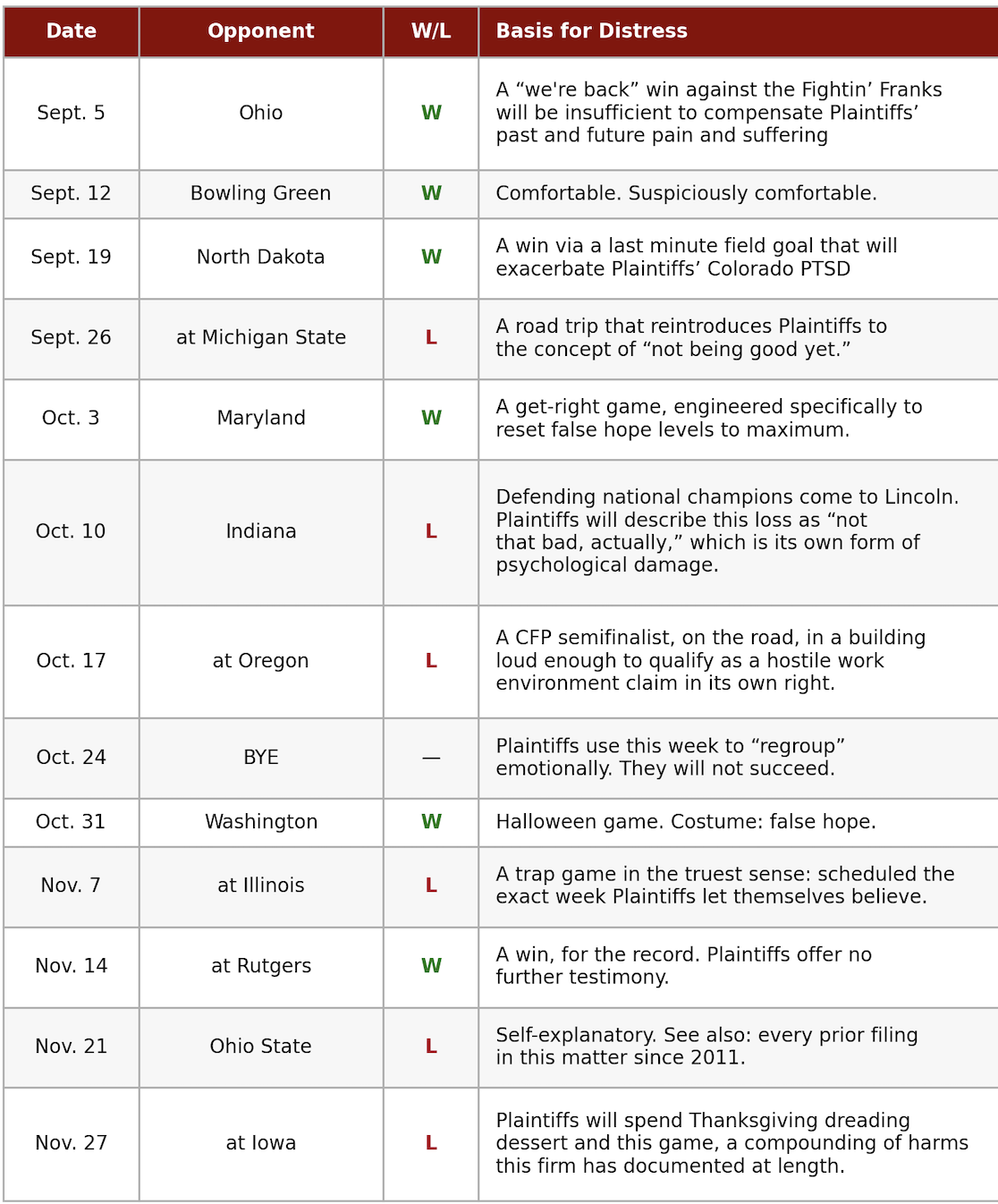
They are in! The post you’ve been waiting for! We’re all, well most of us, are excited for the season opener on Thursday! How does KSB think the season will shake out?

KAREN’S PREDICTION:

Every August, I sit down with my Husker schedule, a bottle of tequila Starbucks, and the eternal optimism of a fan who should know better. This year, I’m predicting something radical: progress. Not a playoff berth, not a Heisman, not a national title—just progress. (I know, how dare I dream so big?)

We start with wins over Cincinnati, Akron, Houston Christian, and—brace yourselves—Michigan. Yes, I said Michigan. Nothing would bring me more joy than watching Steve suffer through a Husker upset—like a discount Harbaugh: old, cranky, perpetually annoyed, but without the titles or the NCAA infractions to make him interesting. (Jordan will be there too, clinging to Michigan’s past glory like a barnacle on Steve’s khakis)

Of course, reality always comes knocking. Cue the “Michigan Hangover Loss” at Michigan State—karma for KSBers letting Matt stroll around in his Notre Dame gear, basically just a Michigan fan in rosary beads still living off Rudy reruns. After that, bounce-backs against Maryland and Minnesota, and another ugly Northwestern win. 

Then November arrives, and so does pain: 

USC? Loss. (And while we’re talking about the Trojans, let’s talk Amanda—our very own Trojan horse. She waited until after we hired her to confess she’s an Ohio State fan. That’s not fandom, that’s deception. Honestly, it’s the most Harbaugh move in this office.)

UCLA? Loss. 

Penn State? Loss. 

And Iowa? The turkey leftovers will taste better. Losing to Iowa is bad enough, but Tyler actually chose to go there for law school—proof some decisions haunt you forever. To make it worse, my son is dating an Iowa fan. Pray for me.

In November, even the beer in Memorial Stadium won’t be enough to dull the pain, but at least we won’t be sneaking Busch Light into suspiciously heavy lemonade cups. The lines will be long, the pours will be light, and the bathrooms a disaster—but hey, progress.

And don’t forget this season’s true victims: the kids banned from selling Runzas. Nothing says “Go Big Red” like killing the only reason anyone could justify paying $7 for hot cabbage. RIP pint-sized entrepreneurs—you deserved better.

So there it is: 8–4. Respectable, sure—but the real tragedy is me turning into the kind of optimist I usually mock Bobby. Honestly, I disgust myself.

STEVE’S PREDICTION

You’ve heard it.  I’ve heard it.  Everyone has heard it.  Year 3 under Coach Matt Rhule is THE year for transformation from plucky underachievers to a 10-win juggernaut.  For the sake of the Cornhusker faithful who surround me, I’d love to believe.  I mean, after 20+ years of making fun of Husker fans, it really does feel like I’m punching down.  So is this the year the Cornhuskers finally break out and return to national relevance?  Narrator: No, it is not!

I see 4 gimme wins on the schedule - Akron, Houston Christian (Community College?  Choir?  Daycare? Church League Softball Team?), Michigan State, and Northwestern.  I also see 2 guaranteed losses - Michigan (of course!) and Penn State. The rest?  It’s like walking into Jordan’s office.  You have no idea what you’re going to find!  I say the Huskers split with Cincinnati and Minnesota; split with Maryland and UCLA; and split with USC and Iowa.  That leaves the Huskers with a 7-5 record, because mediocrity is the new tradition!  Disappointing to some, but good enough for another bowl game.  At least you can still say “Wait ‘til next year!”  And, of course, Go Blue (9-3)!

BOBBY’S PREDICTION

Ah, Vegas, you did it again.  Another year, another betting line over/under 7.5 regular season wins.  Re-rolling a $500 under bet for the last 10 years means you could buy a car at this point.  But here I am, ready to get hurt again.  Unlike some national pundits, I’m not close to predicting a playoff run, nor do I think one is necessary to see “progress.”  I’m predicting 8-4 and a flurry of “was that success” discussions come Christmas.  Candidly, I’m mostly just ready for preseason talking to end.  The only thing I need more is the new Taylor Swift album to drop so I can stop hearing about all the theories from my wife, oldest daughter, and Instagram randos.

Cincinnati: I think we finally get that elusive week 1 win against a P4 opponent in a functional home game. They have a solid DL and a dual threat quarterback that will keep it a game until the 4th quarter.  The Bearcats will test our young DL and remade OL and probably even lead in the second quarter, but we settle in and finally get a solid week 1 win.  Bonus prediction: Jason Kelce is seen slamming beers in the suite wearing his old Bearcats jersey he eventually rips off when they score.  Travis will be well behaved because he’s now pop culture’s first man.  Talk about New Heights.

Akron and Houston Christian: A couple wins that will allow us to play the 2nd and 3rd stringers in the second half.  I can see the headlines now.  Back in the top-25 and “this year’s Indiana” stories abound, tied to clicks but not reality.

 Michigan: As much as it pains me, we’re just not quite there yet.  Sherrone Moore will be watching from Ann Arbor, but we lose this one courtesy of a not-yet-settled field goal kicking unit and inability to move the ball.  Side note, who wouldn’t pay $25 million for a National Title? KGB references were not on my college football bingo card.  Thanks, Connor (THE) Stalions.

 Michigan State: Coming off a bye week, now we start the roller coaster only a fragile yet dedicated fanbase signs up for every year.  I think we get this one at home, but it’ll be too close for comfort.  Still, a win is a win.

Maryland: I have absolutely no clue what to make of this team, but I think Nebraska wins it.  The narrative starts to pick up again with a 5-1 record, “also receiving votes” designation, and a “manageable” schedule through October.

Minnesota: I hate that I’m saying it, because there’s only one place PJ Fleck’s oar should be shoved.  At Minnesota on a Friday night just doesn’t go our way.  It’ll be an ugly, cold loss that stings as much as it should.  Here starts the “what could have been” narrative.

Northwestern: A get-back game at home to reach bowl eligibility.  With unease, people will say at least we made a bowl game for consecutive years for the first time in a decade.  My goodness do people love story lines.  It’ll feel super hollow, but it’ll become the narrative.

 USC: Ugh. Another “not quite there yet” loss.  We need to hope it’s snowing and colder than hell.  I have no idea why Lincoln Riley is going to run it back with Maiava at QB. I didn’t see a Riley-esque star taking snaps when we played them last year, and I don’t think he’s “the guy” to take USC to the playoff.  (But now that I’ve said it, congrats on your Heisman run, kid.)  Black will be the uniforms, matching the color of Steve’s soul and the mood in Lincoln.

 UCLA: I think they have this one circled after the debacle in Lincoln last year.  We pull it out in LA, but it’ll be close.  Raiola leads a game-winning drive to get to 7 wins, and Rhule talks about the mental improvement it takes to win close games.  At the same time people start asking, “Where is this Matt Rhule year-3 jump?”

 Penn State: I think they will be good, but not national champion good.  Still, their depth pretty easily wins out this late in the season even though we have 2 weeks to prepare.  We need to hope for an 11 AM kick to have a shot, because a night game at Coach Rhule’s alma mater just isn’t in the cards for us.  I don’t think it is either way.

 Iowa: Ah, yes, the annual “did they finally find a quarterback” roulette for Iowa continues.  Our Aussie punter puts on a show in the cold and wind.  Nebraska wins another ugly one at home to post 8-4, good enough for a “better” bowl game on a random Wednesday night in December.  Then starts 8 months of “was 2025 a successful year?” banter across Nebraska.

SHARI’S PREDICTION:

It’s so great to have football back!  In our house, we’re looking forward to strong Nebraska and Notre Dame seasons.  Yes, we are Notre Dame fans.  Go Irish!  

Now for the Huskers!  I think this might be their best season in a long time.  I think Dylan Raiola will improve significantly this year and the changes in the coaching staff will all be big positives.  Starting the season off on my birthday in Kansas City, they have to win, right?  The next four home games will all be wins.  Michigan will be a good game and we will have to listen to the KSB Michigan fans (boo Steve and Jordan) all week.  But in the end the rest of us will have bragging rights when Nebraska pulls out the victory.  Hitting the road to Maryland and Minnesota.  I think we will win one - Maryland - and lose one - Minnesota.  The Huskers return home and with the hometown crowd they will get a win against Northwestern.  Our next loss comes against USC at home and that’s the start of the rollercoaster.  Win, loss, win!  We will beat UCLA, lose to Penn State, and then head home and win against Iowa.  We will be set up perfectly for another bowl game.  9-3! Go Big Red!  

COADY’S PREDICTION:

Hope Springs Eternal / Groundhog Day.  Those are the feelings that I regularly experience as I write my annual predictions each year.  Being hopeful because this is supposed to be fun (and not self-loathing).  Groundhog Day because that (false?) hope has often proven unfounded in the past.

Still this year, I am genuinely optimistic that Nebraska has actually improved (especially on the offensive line), and that its growth will also show up in the Win-Loss column.  See also Rhule, Matt (Year 3).  Plus, having five straight home games*** and not having to hit the road for a true away contest until October 11, should give Nebraska plenty of runway to get some momentum going.  I see only one sure loss on the schedule: Nebraska’s November 22 trip to Happy Valley.  I am marking down wins against Cincinnati, Akron, Houston Christian, Maryland, Minnesota, Northwestern, and UCLA.  I have the games against Michigan, Michigan State, USC, and [Tyler J. Coverdale’s] Iowa as toss-ups.  I predict that Nebraska will go 9-3.  Bring it on!

***Sorry, Cincinnati; Travis Kelce’s home stadium is going to look and feel more like Memorial Stadium South than a Bearcats . . . ahem . . . “home game.”

JORDAN’S PREDICTION:

I don’t like the taste, but I have to admit that I’m drinking the Rhule-aid this year.  While I have to hope that the Maize and Blue will provide at least one early season disappointment for the blackshirts, a soft schedule should bring Nebraska into the USC game with at least 6 wins.  Assuming they can go .500 down the stretch, we’re looking at an 8 to 10 win season for the ‘Skers.  If they’re lucky, they might even get a second crack at the Wolverines in December.  In any event, this season should be like a cold, fruity, umbrella-ed cocktail to a fat man at the end of a marathon (or at least a walk around the Lincoln office.)

TYLER’S PREDICTION

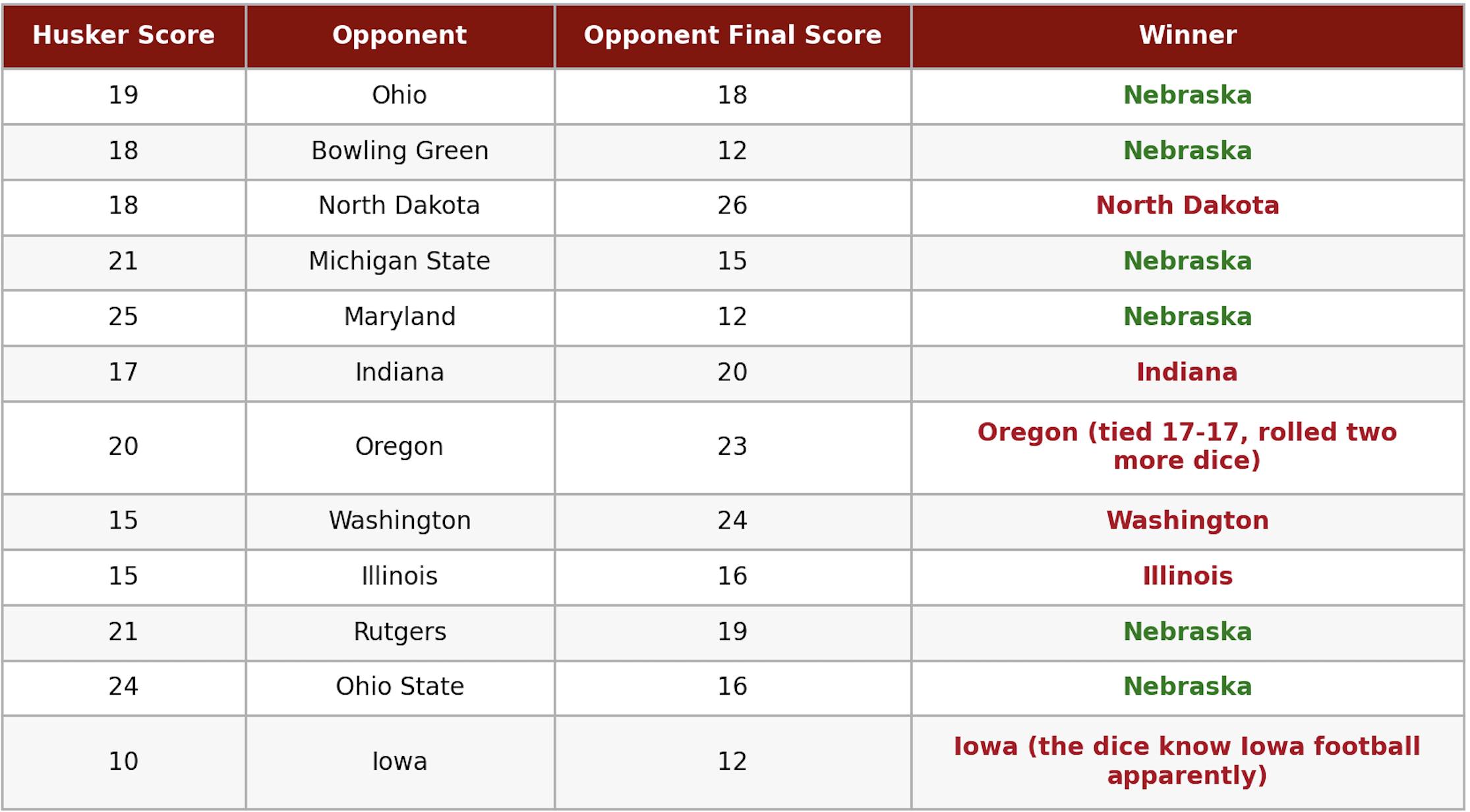
Five years ago, I was in a fantasy football league where a league member did not have sufficient time to properly research his decisions, and thus left all decisions to fate. Fate being, of course, the quarter he found in his car that he flipped for every single decision.

So this year, rather than delve into the blogosphere of Huskermania which is a scary and confusing place to this former Hawkeye, I am instead going to do absolutely no research whatsoever and resign the Huskers to the ultimate decider—the 2015 penny I found under my desk this morning.

Methodology: Opponents are heads, Huskers are tails. Each game is the best 2/3 flips. Clearly I did not flub results or the last game would be different.

Looks like it’s going to be a rough three game stretch in late October/early November since heads came up six times in a row. Also the Penny must have been carried around by the rare Akron/Houston Christian double alumnus for a period of time. 

5-7 and a pretty standard year where the Huskers lose to Houston Christian then beat the Wolverines the next week, and later beat their eastern rival by a score of 9 to 4 or some other nonsense that is typical in those painful-to-watch games (I dropped the coin twice during this match so there will probably be a lot of turnovers in that one). 

SARA’S PREDICTION:

As the KSB resident Husker realist (because nothing screams “millennial coping mechanism” like drafting football predictions while sipping a hazelnut latte and rewatching Gilmore Girls for the 50th time), I’ve reviewed the 2025 Nebraska schedule with all the rigor of a Taylor Swift fan decoding hidden Easter eggs. August kicks off with Cincinnati in Kansas City, basically a road trip that feels like a “Cornhusker Eras Tour” opener. Wins pile up early (Akron and HCU, bless your hearts), but then Michigan rolls in like the villain in every Marvel reboot, reminding us that pain builds character. The mid-season stretch? Let’s just say Northwestern is our “You Belong With Me” moment, while USC and UCLA are the part where the stadium playlist shifts to “All Too Well (10 Minute Version).” The Taylor Swift references, by the way, are in honor of her new album dropping right in the heart of football season, maybe she will give Karen and I royalties for free advertising? (Yes, we know many of you have been personally subjected to the artistry of Taylor Swift music on a webinar with us. Hey T. Swift - if you happen to be reading, I have Venmo!) In true millennial fashion, I’m predicting we’ll end up at a solid 7–5: not too shabby, not too legendary, but just enough to justify buying another Husker crewneck sweatshirt I don’t need. #gobigred 

Ps. Don’t worry, I predict the Huskers will make a bowl game this year. It won’t be anything fancy, but think of it like the streaming equivalent of landing on Hulu instead of Netflix; still solid, still watchable, but with lower expectations of entertainment value. 

AMANDA’S PREDICTION:

Rookie year of predictions? Not bad—I came out of the gate stronger than Nebraska usually does in the fourth quarter. Now in my sophomore season, I’m back at it, taking another swing at calling the Cornhuskers’ fate.

This year, I’m penciling Nebraska in at 7–5. Respectable, bowl eligible, but not exactly striking fear into the Big Ten. Think of it as a season where the fans convince themselves it’s the start of a turnaround—before remembering that The Ohio State still runs the neighborhood. So, how do I see those wins and losses breaking down? Nebraska wins against Cincinnati, Akron, Houston Christian, Michigan State, Maryland, Northwestern, and Iowa. Nebraska will unfortunately take the “L” against Michigan, Minnesota, USC, UCLA, and Penn State. 

Seven wins means the Huskers move the chains a little farther down the field this year. Progress counts—even if the Buckeyes are still marching toward the end zone.

MATT’S PREDICTION:

Another great year for the HUSKERS!!!!

Looking at the schedule maybe 6-6. That’s being nice!

They lose the opener to Cincy 34-28, but blow out wins against Akron and HCU.  Next, Big Ten play!  Nebraska will lose to Michigan, beat Michigan State because the Michigan State offense is bad and can’t score.  Maryland was bad last year and will be at the bottom of the conference again, so the Huskers beat them.  Minnesota will be a good game, I'm thinking 35-31 and the Huskers get the win.  Northwestern is terrible, so another blow out win for the Huskers, but I think the wins stop and they lose to USC, UCLA, Penn State, and also lose a close one against Iowa, like always.  Great news Husker fans, another bowl appearance.

PowerSchool Litigation Update

Did you receive the email about PowerSchool data breach litigation and have questions about what it meant and whether it was something for your school to consider?  Us, too.

The email most clients received is specific to a “mass action” (not “class action”) that has been consolidated in the Southern District of California.  Within that litigation, the school plaintiffs are alleging that PowerSchool breached its contractual obligations to keep data secure and caused administrators to spend time and effort responding to the breach, among other claims.

KSB contacted school attorneys we know in California who are directly involved in the PowerSchool litigation. Specifically, we spoke with Shiva Stein and Mark Williams from the F3 Law firm, who are partnering with the Frantz Law Group—the firm that sent you the initial email. They provided us with a case status update and shared practical details, including the administrative steps for schools that join, how to get started, and the prospects for recovery or settlement.

Shiva and Mark have offered to jump on a zoom to share this information directly with you and answer questions from any schools that may be interested.  The zoom webinar will be held on Wednesday, August 27th at 12:00 CT.  If you’re interested in listening in to this discussion, sign up here.  We’ll also record the zoom so you can access it later if you can’t attend live.  You can also take a look at an explanatory letter about the litigation by clicking here and a litigation FAQ document by clicking here.  Both were prepared by the F3 Law team.

Here are our initial thoughts.  We know you’ve had opportunities to join similar lawsuits—opioids, vaping, and social media, to name a few. The PowerSchool case is different because it involves individual claims from each school rather than a class action. In our view, it’s worth gathering more information for you and your board to consider. With multiple lawsuits already underway against PowerSchool, you may soon face a join-or-opt-out decision anyway. We think the Frantz Law Group/F3 approach offers more control over the process and potential recovery.  As we understand it, they are offering to represent schools on a contingency basis, meaning you shouldn’t have attorney costs unless your district recovers money from the litigation.

If you’d like to talk with one of us about the litigation first, we’re happy to do so.  Give us a call or shoot an email to ksb@ksbschoollaw.com.  Otherwise, consider joining in the Zoom discussion and let us know if you’d like to talk it through after.

**Even though you are already a KSB client and/or elected to receive blog posts from us, it’s possible this blog post is technically considered an attorney solicitation or advertising material.  KSB is not joining in the litigation or giving legal advice to you or those who are involved on the merits of the claims.  We are trying to get the schools we serve information to help them make decisions.** 

Building Your 25-26 In-Service Schedule

In-services. Love them? Hate them? They are a necessary tool built into school calendars. Now that you have your first professional development days of the school year under your belt, now is the time to think about your in-service offerings for the rest of the school year. We noticed with your client satisfaction survey that many schools indicated an interest in new in-service sessions. Look no further! We have a brand new slate of 25-26 in-person in-services for you. Each can be customized to fill the time you have allotted, and we promise your staff will not be bored as a stiff attorney drones on and on. All of these sessions have a target audience of teachers/administrators in a school. 

1. Staying Out of the Headlines: Boundaries, Technology, and Education Professionals

Topics: Employee conduct, online/digital use, professional boundaries, negligence

In a world where one selfie can spark a scandal, you need a digital game plan. We’ll cover what’s safe to share, how to keep boundaries crystal-clear, and how to sidestep those “Why is the superintendent calling me?” moments. Your reputation—and job—will thank you.

2. SPED Declassified: Teacher Survival Guide

Topics: Special education for general education teachers, Section 504, IEP implementation

IEPs and 504 plans aren’t just paperwork—they’re legal documents with serious weight. We’ll translate the alphabet soup of special education into plain English (you know - those acronyms you might have forgotten since college), show you how to meet your obligations without burning out, and keep you compliant (and calm) when the stakes are high.

3. Rulings and Regulations: Real-Life Classroom Implications

Topics: New laws and court decisions—local, SCOTUS, and court rulings

Education law changes faster than the school lunch menu. We’ll break down the newest rulings and regulations, what they actually mean for your classroom, and how to adapt before your next parent conference turns into a legal lesson.

4. Negligence and Supervision: How Teachers can Avoid Liability for Themselves and their Schools

Topics: Student supervision, school safety court cases alleging that teachers, coaches or other staff were negligent 

This session unpacks real court cases involving claims of negligence against teachers, coaches, and staff. We’ll cover practical strategies for student supervision, how to spot risky situations before they escalate, and what steps protect both you and your school from legal fallout

5. Screens, Scandals, and School Rules: What Every Teacher Should Know About Student Devices

Topics: Student digital device use, mental health implications, searches, discipline limits, cyberbullying, cell phone bans, sexting, exploitation

From TikTok trends to text threads, today’s devices bring legal, safety, and mental health challenges straight into the classroom. We’ll cover when you can (and can’t) search a student’s phone, what behaviors can lead to discipline, and how to spot the warning signs of cyberbullying, sexting, or exploitation. Plus, we’ll talk about the mental health impact of constant connectivity and how cell phone bans are playing out in schools.

Looking for on demand content? We have a back-to-school in-service video (but can be utilized at any time!) that is budget friendly and a quick 35 minutes for staff regarding ethics, professional boundaries, and mandatory reporting. If you would like to book a KSB attorney for a staff in-service or check pricing, shoot us an email at ksb@ksbschoollaw.com

The 2025–26 KSB Webinar Lineup Is Live

The 2025–26 KSB Webinar Lineup Is Live

We build our webinars the same way you build your day: around whatever’s on fire.  The 2025–26 lineup is no exception. Whether you’re new to your role or just looking to stay ahead of the legal curve, our webinars are built to give you timely, practical support—with just the right amount of dry humor and digital handouts.

We offering two types of learning experiences:
• Our Quarterly Webinar Series, open to all districts
• Our Nebraska-only Rookie and Refresher Series, with monthly strands for superintendents, principals, special education staff and board members. 

Quarterly Webinar Series (Open to All)

These are three-hour, deep-dive sessions on the hottest legal issues in public education. Each one includes materials, examples, and time for real discussion.

2025–26 Topics:
• Parental rights and opt-outs
• Special ed for general ed leaders
• Testifying in legal hearings
• Activities law, eligibility, and NIL issues

Cost: $1,250 for all four webinars or $325 per session per district. One registration covers your entire building team.

Click here for full session descriptions and to register 

All sessions include access to materials and recordings. You can register for the full series or choose the topics that fit your needs.

Nebraska-Only: Monthly Rookie and Refresher Series

Back by popular demand for 2025–26 with updated content and practical strategies that track the school year in real time.

Principal Series
Starts Sept. 3. Covers special ed, student discipline, evaluations, FERPA, and more.
Click here for full session descriptions and to register

Special Education Series
Starts Sept. 17. Follows one hypothetical student through the IEP cycle with practical, legally sound guidance.
Click here for full session descriptions and to register

Superintendent Series
Starts Sept. 23. Focused on legal fundamentals and timely leadership responsibilities—from contract negotiations and teacher employment to public records, FERPA, and navigating board meetings with confidence.
Click here for full session descriptions and to register

Board Series

Ten short, practical videos built for use in real time—whether your board members watch individually or you embed them into your monthly meetings. Covers everything from confidentiality and executive session to discipline, superintendent evaluation, and individual board member liability. Those who register will also receive updated content throughout the year based on recent changes in Nebraska law.
Click here for full session descriptions and to register

If you're a Nebraska district, you're in. If you're outside Nebraska and wish you had this kind of access, let us know—we’re listening.

*We appreciate those of you who have filled out our client satisfaction survey. If you haven't, please do so here. Based on your responses, we’ll be offering a full training subscription option for the 2026–27 school year. If you'd like access to all available training content on the KSB Portal for this year, please email Shari.

**Most folks assume they’ll just use the same evaluation tool as last year—and that might be fine. But if you’re open to something better, we’ve just launched a new evaluation platform for superintendents and principals. A handful of pilot districts helped us build it, and it’s ready for broader use. Curious? We’re happy to show you around.

***Finally—don’t forget about Title IX. Whether your team needs full team training, “slim” policy training or all staff training, we’ve got options that are easy to roll out and meet federal requirements.